Skip to content

My current thoughts on PR/“more parties” reforms

What follows is mainly for me, but maybe it is useful.

I would view list-PR adoption as an ‘insulating’ action by a coalition that is hard but not impossible to put together. The same would go for national/widespread imposition of ballot fusion (also see first link).

I am wary of efforts to promote PR for its own sake.

I think we are going to see (or at least hear about) more reform activity than usual in cities and maybe some states. It would be nice to see this go in the “more parties” direction.

I prefer to say “pro-party.” I don’t think that direction has to alter the party system by, say, causing lots of parties to win seats in Congress or run presidential candidates.

Even locally, I am reluctant to say it would be easy to build a pro-party reform coalition.


How much should we focus on the number of parties?

Two motives currently define demand for a system of proportional representation (PR). One is to increase the number of parties. Another is to bring parties’ seat shares closer to their vote shares, regardless of how many parties there are.

Two motives accordingly define opposition to PR. One invokes governability issues from an increased number of parties. The other, which we do not hear in public, is that PR would benefit the party (coalition) whose voters concentrate in population-dense areas.

So, one flavor of opposition and one flavor of support share a premise that PR increases the number of parties. This short post aims to share some data on the validity of the premise. What I take from these data is in line with something I wrote last summer: “the current conversation is too focused on the number of parties.” By that I meant both opposition to and advocacy of PR.

Below are some data from Calvo (2009). (I would include the link if I could find it.) That paper argued that districting considerations — not a desire to improve representation — are fundamentally responsible for PR adoption in Western Europe.

Our first set of graphs focuses on the “effective number of [electoral] parties” (ENP) in lower chambers. In these graphs, an empty data point is an election without PR, and a filled data point represents an election under PR. As a benchmark, ENP in United States House elections typically is within 0.1 of 2.0. ENP tells us what voters are doing, possibly but not necessarily in response to PR adoption.

The graphs above show increases in the number of parties in advance of PR adoption— but not mechanically and not in all cases! Also, only one case shows a proper post-PR ‘jump’ in the effective number of electoral parties: Switzerland. I argue elsewhere that this is because the Swiss PR adoption was a ‘realigning’ episode, made possible by prior adoption of nationwide initiative-and-referendum. Lutz (2004) thus calls the Swiss PR adoption “reform from below.”

Bottom line: the number of parties may have mattered but not in the way some argue: things ‘pressing’ for and being given representation. Rather, and channeling Calvo (2009), multiparty politics made it so that majoritarian electoral rules could no longer be relied on to deliver majoritarian outcomes. Here is a stylized story for any of the above plots except Switzerland (again, reform “from below”). Dealignment, possibly due to an influx of new voters, begins putting pressure on incumbent party leaders and legislators. They debate what to do for a while. Then they conclude that the best way to hang onto power might be to adopt PR.

Here are data on the “effective number of legislative parties” (ENLP), or the size-adjusted number of parties actually in the legislature. They do not look very different from the data on ENEP.

Both measures suggest that PR does not much affect voting behavior, at least in the short term. In turn, this suggests that PR probably does not do much to harm governability. Rather, in a world where governability matters, PR adoption more likely stems from a desire to preserve “governability” — by the coalition adopting it!

Below is one more look at ENP, this time with data from Blais, Dobrzynska, and Indridason (2005). This look includes the Anglo settler democracies, which many readers will want to see. Here, a filled dot represents the first election under PR. An empty dot represents an election under plurality, and an empty triangle represents an election under strictly majoritarian rules (runoff, Alternative Vote). The key thing to note, especially for the Anglo democracies, is that an increase in the number of parties does not mechanically cause PR adoption. Other things are going on.

We are at a point when many people like the idea of PR. More precisely, many have become comfortable with, if not supportive of, an increased number of parties in the United States. (That is a sea change from when I entered this research area.) I agree that under certain circumstances, multiparty politics with PR is a good idea. My point is that the number of parties gets more attention than it should — as a threat to governability, as a ‘stepping stone’ to PR, and maybe as an end in itself.

What matters more than the number of parties is that majority coalitions, be they single-party or alliances of parties, can win majorities of legislative seats and then hold themselves together between elections. (I am nearly plagiarizing myself, except that I am citing myself.) If those ideas sound good, you want two things: a system of proportional representation, then one in which a party’s leaders have the tools to discipline their rank-and-file.


Perspectives on Politics reviews More Parties or No Parties

I am deeply thankful to Todd Donovan for this review of my book. It introduces points I have not been able to cover in public-facing writing. These include parts of the theory, what happened with STV between its adoption and repeal, and the spending effects as linked to campaign strategy.

Like the book, the essay draws on the fields of urban and comparative politics. Todd’s own work on the topic is very much worth reading.


Teaching Shefter (1986) in November 2023

I just finished teaching/discussing a classic article on NYC party politics in the 1920s-50s. It was an interesting coincidence that the Working Families Party had just done well the day before in some Northeastern cities. (The Libertarians also did well, but that is a potential connection for later.)

Shefter’s piece is not easy to read. It was one of the first to run in Studies in American Political Development. The theory casts “political incorporation” and “extrusion” as “two sides of the same coin” of the handling of “new social forces” in American politics. All these terms need interpreting.

The argument also rests on details about many forgotten local politicians. That is a lot to keep track of. It also mentions interest groups, both formal (like the Citizens Union) and informal (like the mafia).

I taught the piece with pictures of the underlying coalition structure, light discussion of the electoral institutions, and a bit on the then-emerging New Deal party system. (The other key part of the theory is a “crisis” or “realignment” in/of the party system.) Then we interpreted the key terms. Then I had students look up names from the article (La Guardia, Marcantonio, O’Dwyer, Powell, etc) and try to say how their portrayals supported the theory.

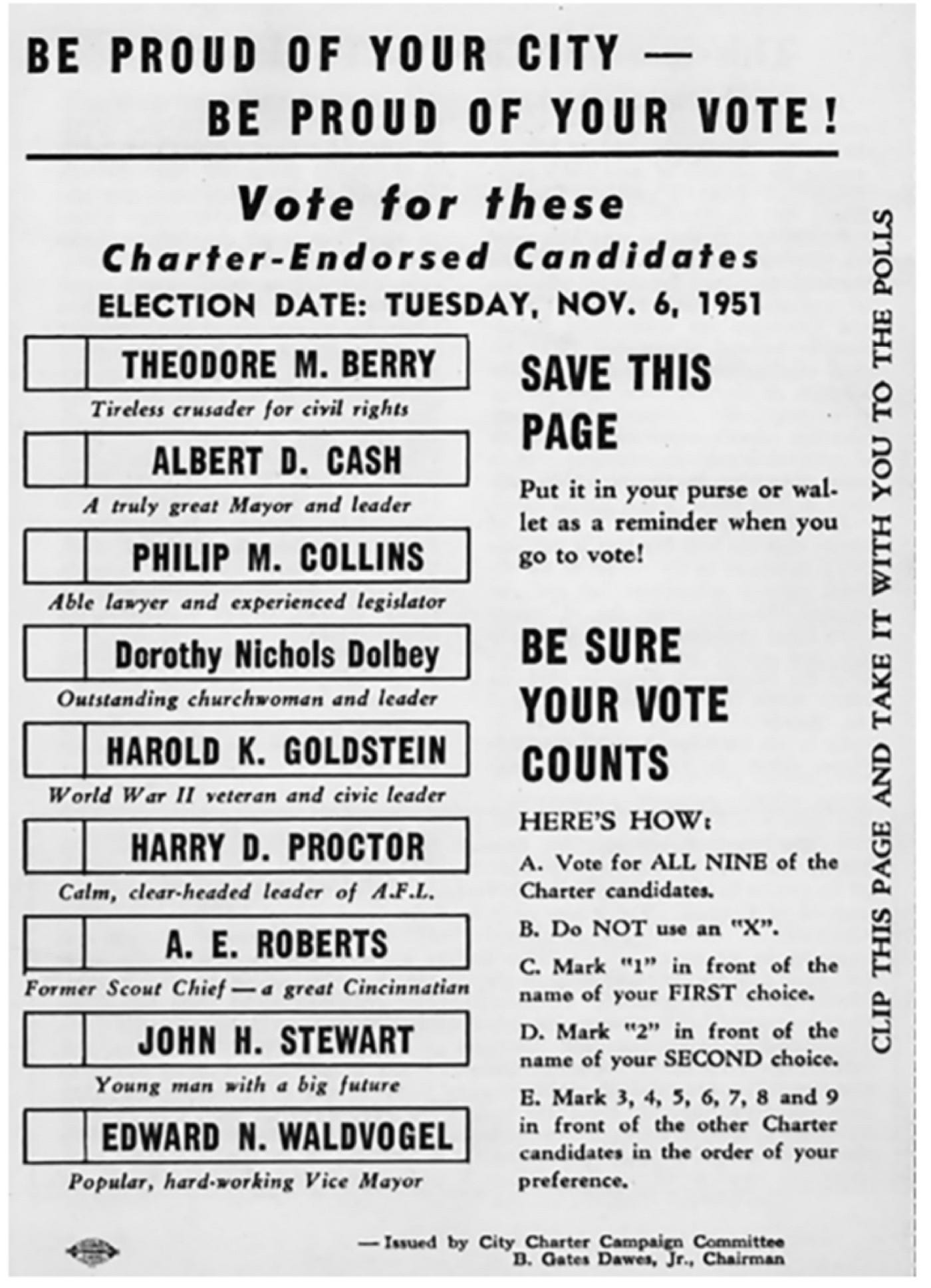
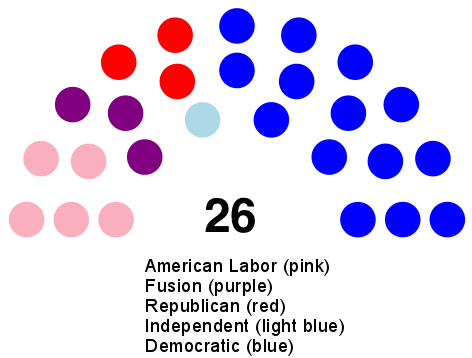
Here is the initial post-reform coalition structure. By reform I mean the institutional changes of 1936.

Here is the coalition structure as the institutions were about to change again.

There are clear differences, and these mapped nicely onto details in the article.

The images are illustrative, not authoritative. I made them several years ago. The newer representation of these data was done instead by scaling everything together (due to the attendant research purpose).

I did not bring up the WFP at all. One student did mention AOC, and we discussed how well the framework fits her trajectory, which historical figure seems most similar, etc.

I have been thinking a lot about how all of the above relates to nationalization, as well as another book I look forward to reading on that.


The government-spending effects of Progressive Era reform charters

There has been a boom of late in estimating the policy effects of historic local-government reforms. Those were often tied to forms of preferential voting. I want to share what I found when I did my own study of spending effects.

The takeaway is: higher aggregate spending under a council-manager charter that included single transferable vote (STV), compared to cities with non-STV manager charters, as well as cities whose ‘form’ of government didn’t change. I argue that this is to be expected, based on how the STV-manager charter combined the logics of “neighborhood representation” and “citywide focus” (both of which are common phrases in reform-practice circles).

The variety of reforms

Progressive Era municipal reforms came in three main flavors. One class strengthened directly elected mayors relative to local assemblies. It is not common to call this a “reform charter.”

Two more inaugurated the infamous ‘at large’ election. (On infamy, see Trebbi et al. 2008 or this new paper by Grumbach et al. 2023.) These also seem to have reduced the sizes of local assemblies.

One of them, the commission form of government, attempted to hold citywide elections to a series of functionally defined offices. Over time and to varying degrees, this morphed into a ‘numbered post’ electoral system. My former research assistant Andrew Rosenthal and I found nearly 100 such cases that came with an early form of ‘instant runoff.’ It is clear from historic advocacy materials that popular interests in preferential voting and more businesslike administration reinforced each other in helping commission government to spread.

The second at-large charter was designed, in part, to be compatible with some form of proportional representation (PR). It also aimed to piggyback on the joint popularity of preferential voting and businesslike administration. This was the council-manager form of government. It achieved compatibility with PR by junking the numbered posts.

Recent research

Two recent papers supply the impetus for this post. One from Carreri et al. (2023) finds limited effects on a range of inequality measures (pp. 13-14) from at-large-charter adoption, 1900-40. Another from Sahn (2023) disaggregates the two reform charters and points to greater capital outlays, 1900-34, from council-manger adoption. This is important; recall the “citywide focus” that council-manager is said to promote. (Also see Hankinson & Magazinnik 2023 on housing policy under at-large elections.)

There probably are other recent papers. I do not follow the historic urban political economy literature as closely as I might. I got to the topic by trying to say something about the effects of the reform I was studying (STV as embedded in a municipal reform charter).

Party competition in nonpartisan elections

My analysis used the data from this paper and focused on the period from 1930-60. This is important because, in 1932, the National Municipal League (NML) formalized the following policy: urge local reformers to form a “good government” party in any city where NML also was promoting council-manager. So, when we estimate the spending effects of these institutions, we may be picking up effects of the styles of party coordination they engendered.

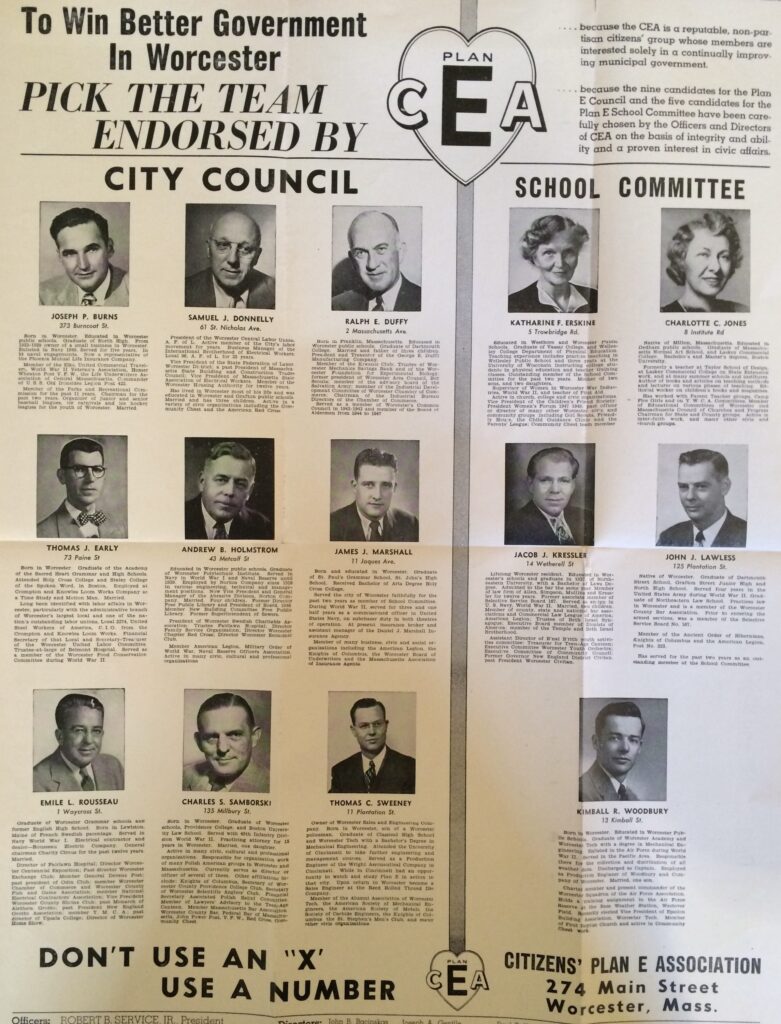
It is worth noting that the new STV-manager charter in Portland (OR) once again has local reformers figuring out how to organize slates.

I argued that STV’s collision with a reform charter should lead to higher per-capita spending than non-STV charters and the absence of reform. The reason is that STV turned “good government” slates into “parties of neighborhoods.” The openness of an STV election made it unwise for reformers (now seeking to control government) to ignore (or harm) any given neighborhood. Evidence that politicians were thinking along these lines appears in the chapter. It includes first-choice vote shares by ward (when available), stories about campaign strategy, and stories about legislation (spot zoning, holding up slum clearance, etc). There also is a comparative literature on “localism” in STV elections (see, e.g., Carty 1981 on Ireland).

Here is the key table. “Plurality charter” really means “non-STV manager charter.” Unreformed city is the reference category. What this means is that the data do not record a change in form-of-government.

What we see above may combine what I’ve said about STV, plus the capital-outlays finding from Sahn.

The data in the other papers is better than what I used. Diff-in-diff also went into convulsion as I was writing my chapter, so I fell back on two-way fixed effects. I also did an RDD with pre-1930 data at one point, and that turned up no effects.