Learning management systems, and Brightspace
I just attended an excellent workshop on the Brightspace platform (courtesy of WNE). Here are thoughts on how it compares to other learning management systems (LMS) I’ve used.
Read more…by Jack Santucci
All posts related to pedagogy.
I just attended an excellent workshop on the Brightspace platform (courtesy of WNE). Here are thoughts on how it compares to other learning management systems (LMS) I’ve used.
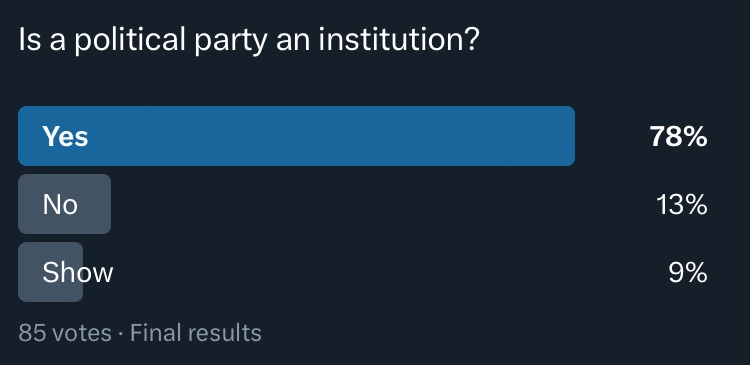
Read more…This post’s purpose is to put down thoughts related to a conversation I had last night. One point concerns the defense of parties. Another concerns the nature and explanation of the two-party system.
I like to use student-generated data to illustrate course concepts. The core of the exercise in this case is a survey the students wrote, to which I added standard items on party identification and self-reported ideology.
The students’ 30 items covered many topics, some of which were very salient and others less so (which is good). I recall there being items on a TikTok ban, mask mandates, existence of climate change, trust in politicians/parties, and even attitudes toward the UK.
I plan to go back to these data as we move through the course. For now, the goals are to illustrate party identification, ideological self-identification, and revealed ideology; see to what extent these hang together; and just see what other things come to mind as we discuss the results.
Read more…I have some students working with spreadsheets for a class project. This looks like a great resource for making the learning fun.
This is a work-in-progress. I will update and add to it.
This skeleton outline assumes you (the student) have been asked to write a paper of roughly 2-5 double-spaced pages. It also assumes you are responding to a prompt.
Introductory paragraph — This tells us why the topic is interesting and gives your thesis statement. Your thesis statement is your point. It’s the thing you want a reader to remember once they’ve forgotten the rest of what you wrote. It should respond directly to the prompt. Since any point can be broken into parts, a good introductory paragraph also tells us what each (or most) of the later (body) paragraphs will argue.
Definitions paragraph — This is for defining and explaining any terms on which your point is based. For example, you may have been asked to say whether some real thing in politics conforms to a definition. How can you do that without giving the definition? Also, if you put effort into this paragraph, the rest of the paper will be much easier to write.
Your professor may rely heavily (but not only) on this paragraph to judge how much you learned… and how efficiently you read.
Body paragraphs — As many as are necessary. Your argument contains more than one idea, and you may be working with more than one definition. Consider writing one paragraph per idea/definition.
Conclusion — Restate your argument, and remind the reader of the logic/evidence that supported it.
If you want, you may conclude with a brief ‘meta’ comment on the prompt or the concepts it asked you to use. This is where you put the point that wasn’t relevant to the answer to the prompt, but that you really wanted to make anyway.