Data on historic use of STV in U.S. cities
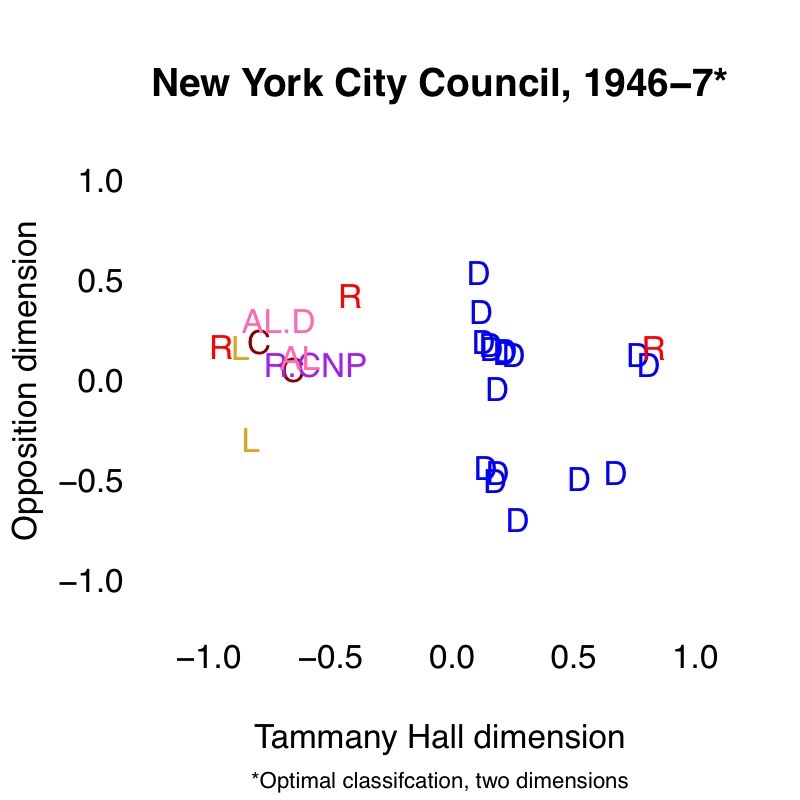
All original data from More Parties or No Parties are stored here.
by Jack Santucci
All posts related to More Parties or No Parties: The Politics of Electoral Reform in America.
All original data from More Parties or No Parties are stored here.
I am deeply thankful to Todd Donovan for this review of my book. It introduces points I have not been able to cover in public-facing writing. These include parts of the theory, what happened with STV between its adoption and repeal, and the spending effects as linked to campaign strategy.
Like the book, the essay draws on the fields of urban and comparative politics. Todd’s own work on the topic is very much worth reading.
How we understand Los Angeles matters. I claimed in a recent piece that the 1913 defeat of open-list PR there was a critical juncture for American PR advocacy. (I recently learned of a similar event in Western Europe, with the opposite effect. More on that another time.) Recently, there appeared two articles saying that the referendum was on STV. So, which was it?
Read more…
The school held an event on May 9 to recognize authors and editors of books and high-impact articles published in 2022. Here is the official page.
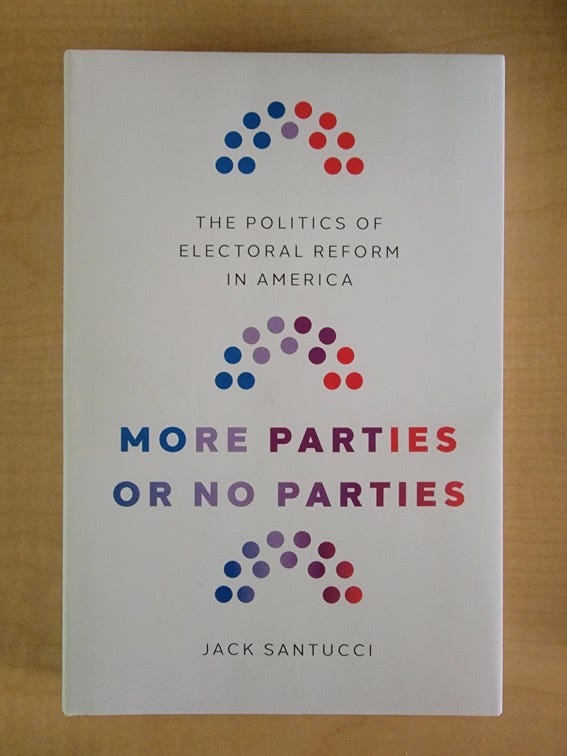
Photo by Phil Howe. Book available for purchase and in Oxford Scholarship Online.
The space of politics is multidimensional. What we call “left” and “right” are negotiated positions.
Interest groups (broadly understood) do the negotiating. They are assumed to want control of government. They form coalitions to get it.
Every democracy has some coalition structure, even if it does not track party division.
‘Shifting coalitions’ lead to electoral reform: incumbent groups seeking insulation, out-of-power groups seeking realignment, or opposing groups seeking to discipline noncommittal players (a polarizing mode).
Electoral reform is change in any of five electoral-system components: assembly size, district magnitude, ballot type, allocation rules, and rules about nominations.
Two-party politics makes it tempting to cater to factions, not parties, when proposing and designing reforms. Witness the current emphasis on ballot type and nominations (ranked-choice, approval voting, nonpartisan primaries). Witness the unpopularity (outside political science) of allocation rules that presume party grouping (such as party-list proportional representation, including mixed-member).
In the past, reformers promoted single transferable vote (STV) and ranking generally in order to cater to factions, not parties.
In other countries, multiparty politics facilitates use of ranked-choice: giving voters understandable entities to rank, instructing voters on how to rank (vote management), regulating candidate entry (vote management), and generating political will to administer a complex system.
In the United States, ranked-choice reforms tended to last as long as the coalitions that imposed them.
Vote management was imperfect and slow to emerge. It usually involved a bipartisan coalition that sold itself in “good government” terms.
Due to vote management, STV produces winners who usually would be the same under open-list proportional representation (OLPR).
An exception is when the coalition structure shifts, such that some voters do not rank candidates in the way that party (or interest-group) leaders might want. Said voters are part of a coalition structure that is different from the prevailing one.
If the alternative coalition deprives “left” and “right” of control of government, they may join in blaming the electoral system. This can lead to a polarizing repeal episode.
Reasons for abandonment of majoritarian ranked-ballot rules are not yet well-understood. One theme in the literature is ranking truncation. Another is the production of surprise results. These may have reinforced each other: many voters not ranking very many choices, determined candidates capitalizing on this.
The repeal of early ranked-choice systems left in place features that had been needed to pass ranked-choice. These include nonpartisan ballots, numbered-post elections, and single-digit assemblies.
This post also appeared at on Medium.