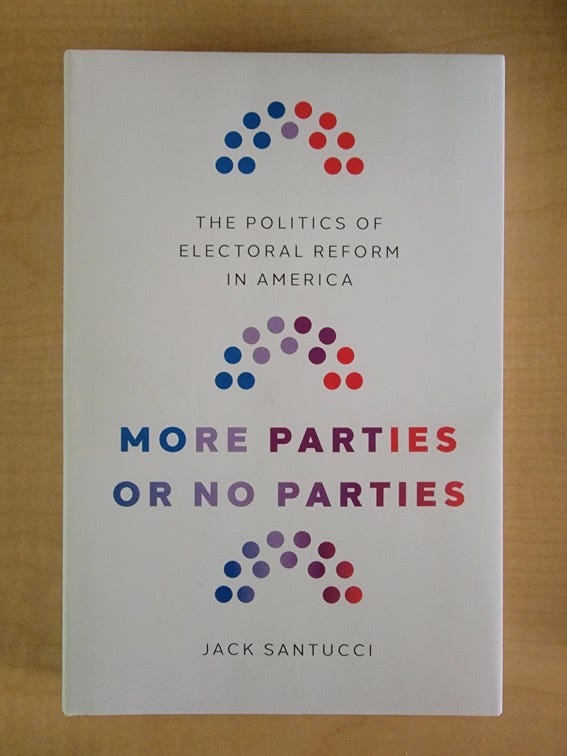
The Fulcrum has a piece on “opening” New York State primaries. It makes a familiar argument:
Primary elections are crucial to our electoral outcomes because they determine which representatives have a better standing in the general election.
There is nothing stopping independent voters from running a candidate in a general election — except maybe their inability to agree on that candidate.
And getting people to agree on one candidate (or technically a number that can win) is a major reason why “parties” emerge.
I put “parties” in quotation marks for two reasons. One is that many hear it as an anti-reform cudgel. The other is that “parties” may not track the two-party divide. I am thinking here of quasi-party organizations like Cincinnati’s Charter Committee or the Murkowski organization in Alaska.
Numerous public officials have won office as independents. Names that come to mind include Bloomberg, Lieberman, Ventura, and Weicker. Each of them did so on their own ballot line in a general election.
It’s time to retire the claim that nominating primaries equal disenfranchisement.
The local paper of record has endorsed RCV in the context of a crowded Democratic mayoral primary. It also has called for nonpartisan elections (potentially with runoffs). How the latter might affect the former is left to the reader.
The endorsement followed a poll by several pro-RCV groups. One is pushing simultaneously in Harrisburg for open primaries.
I have been following the issue since I got here in early 2019. The Philadelphia Citizenwrote about it in 2016. There were murmurs of interest in good-government circles but not much more. (Hence we found the site useful for a survey experiment.) National groups became vocal in Spring 2021, shortly after New York City adopted RCV for primaries.
I discussed the issue on Philly NPR in late April.* Billy Penn ran a story earlier that week.
Here is a piece I wrote in October 2021. It recommended open-list proportional representation. (The conversation at the time was less mayor-centric.) It also noted that a Philadelphian had invented list PR in the 1840s. This was partly to address the unpredictability of runoffs.
*The interview refers to me as an assistant professor. I am flattered but not one.
The space of politics is multidimensional. What we call “left” and “right” are negotiated positions.
Interest groups (broadly understood) do the negotiating. They are assumed to want control of government. They form coalitions to get it.
Every democracy has some coalition structure, even if it does not track party division.
‘Shifting coalitions’ lead to electoral reform: incumbent groups seeking insulation, out-of-power groups seeking realignment, or opposing groups seeking to discipline noncommittal players (a polarizing mode).
Electoral reform is change in any of five electoral-system components: assembly size, district magnitude, ballot type, allocation rules, and rules about nominations.
Two-party politics makes it tempting to cater to factions, not parties, when proposing and designing reforms. Witness the current emphasis on ballot type and nominations (ranked-choice, approval voting, nonpartisan primaries). Witness the unpopularity (outside political science) of allocation rules that presume party grouping (such as party-list proportional representation, including mixed-member).
In the past, reformers promoted single transferable vote (STV) and ranking generally in order to cater to factions, not parties.
In other countries, multiparty politics facilitates use of ranked-choice: giving voters understandable entities to rank, instructing voters on how to rank (vote management), regulating candidate entry (vote management), and generating political will to administer a complex system.
In the United States, ranked-choice reforms tended to last as long as the coalitions that imposed them.
Vote management was imperfect and slow to emerge. It usually involved a bipartisan coalition that sold itself in “good government” terms.
Due to vote management, STV produces winners who usually would be the same under open-list proportional representation (OLPR).
An exception is when the coalition structure shifts, such that some voters do not rank candidates in the way that party (or interest-group) leaders might want. Said voters are part of a coalition structure that is different from the prevailing one.
If the alternative coalition deprives “left” and “right” of control of government, they may join in blaming the electoral system. This can lead to a polarizing repeal episode.
Reasons for abandonment of majoritarian ranked-ballot rules are not yet well-understood. One theme in the literature is ranking truncation. Another is the production of surprise results. These may have reinforced each other: many voters not ranking very many choices, determined candidates capitalizing on this.
The repeal of early ranked-choice systems left in place features that had been needed to pass ranked-choice. These include nonpartisan ballots, numbered-post elections, and single-digit assemblies.
I spent a chunk of Memorial Day weekend writing up some thoughts on fusion. They apparently are part of this case (which does not affect my views). Here is the opening paragraph:
I have been asked to share some thoughts on political parties, democratic stability, and the relationship of each to ballot fusion (understood here to mean cross-endorsement). What follows is based on my doctoral education and ongoing research into so-called ‘multiparty reforms.’ A key theme will be that the number of parties matters less than whether the electoral rules facilitate coalition, then make such coalitions unambiguously known to voters. Cross-endorsement fusion has desirable properties on both fronts: promoting coalition, then telling voters on the ballot what coalition they aim to place in control of government.
The ideas in the ‘expert report’ are based partly on material from an early draft of my book, but which I decided to save for stand-alone publication.
That part of the book deals with “making reform work,” especially against the joint backdrop of presidentialism and the Electoral College. I might as well share the language now.
No consideration of multiparty American democracy is complete without attention to the presidential system of government. There are two big problems: the Electoral College unit rule, then the so-called separation of powers. I will suggest ballot fusion as a way to deal with both. The reason is that it promotes more efficient bargaining than the leading alternatives, namely, ranked-choice voting and runoffs.
In the American system of presidential elections, a third-party candidacy poses two big threats. One is that the trailing candidate may win the election — not only because the system advantages low-population states, but also due to spoilers in electorally pivotal states. Another is that there may not be a majority in the Electoral College, throwing the decision to the House of Representatives (where each state delegation votes in block). The strongest institutional explanation for our two-party system is the “unit rule” allocation of a state’s electors to the popular-vote winner in said state. This system solidified in 1836, not accidentally alongside the two-party system itself (E. J. Engstrom 2004). Had we become democratic in the era of multiparty democracy, it is likely we would use some other method to elect the President. Clearly, if we are to have majority rule and multiparty government, there needs to be some new mechanism for presidential elections.
With either problem, the issue is to promote bargaining, leading to some coalition with majority support. One possible option is electoral fusion. Under fusion, two or more parties nominate a single candidate, and voters may support that candidate on as many ballot lines as there are nominating parties.
Fusion is not the same cross-filing, which allows the candidate to choose which party labels appear near their name (Masket 2009) […]
Fans of other systems (e.g., runoffs, single-seat RCV) may counter that their preferred remedies achieve the same result. […] One thing is certain, however. Under fusion, the incentive is for two or more parties to agree on just one candidate. They do not compete for votes: first-choice, second-choice, or otherwise. Rather, they pool effort behind victory for the coalition. Evidence also suggests that fusion increases voter turnout, mainly by mobilizing voters who do not turn out for either major party (Michelson and Susin 2004; Kantack 2017). For more information on fusion, including its history in American elections, see a comprehensive book by Lisa Disch (2002).
At this point, some may note that no proposal deals with the Senate. Even if we can design a system for multiparty coalition within the separation of powers, the Senate still entrenches a minority veto. Further, the critical determinant of this veto — an equal number of Senators per state, regardless of population — cannot be removed from the Constitution.
My expert report only deals indirectly with the presidentialism issues above.
Maine voters will decide in November whether to use the alternative vote (AV) for single-winner elections. AV lets voters rank candidates. If no candidate has an outright majority, voters’ lower rankings come into play. Many now call this “single-winner ranked choice voting.” Why does AV have traction? If it wins, how long can we expect it to last?