I recently wrote a post for 3streams on ten types on RCV. What sorts of campaigns might they engender?
The working assumption here is that two sides will emerge in politics. They may not track party lines, but they should be identifiable if one looks at the rightdata in a context where the system is ‘settled.’
To summarize the 3streams post, these systems can be used to try to get any of three things: single majority winners, majority-slate sweeps, or both sides represented in a multi-seat district. It is a bit more complicated than that, but this serves to introduce the ideas that follow.
“Anybody but X” campaigning and/or electioneering. Look for this in STV and maybe AV/IRV when they are working ‘well.’ Laver (2000) pointed to this logic in a chapter on government formation.
Slate formation. Look for this in any of the multi-seat systems. Savvy candidates would want to benefit from their “vote pooling” properties. Maja Harris has been following this in Portland (OR).
Spread-the-preferences (STP) strategies. This term is from the comparative literature. It means optimizing two imperatives: run a number of candidates that can win, and ensure a more-or-less even distribution of their first-choice votes. Neighborhoods are therefore good for recruiting candidates, doing GOTV, and possibly targeting policy benefits. Watch for STP in STV and bottom-up. I need to think more about BPV. I don’t see it as a factor with numbered-post.
Fragmentation in primaries. I need to think more about this. One, running for a nomination often is not the same as running to win power. Two, that is what our best source on the history reports. Three, most papers on “exhaustion” (IIRC) point to non-majority winners emerging from fragmented fields. Four, the game theory I have seen suggests that candidates appealing to the same group of voters may not have an incentive to encourage ranking (among other issues).
Nonpartisan primaries (so-called). I have no clear prediction beyond “anybody but X.” And yet there is the game theory I just mentioned.
I may update this later. Thanks to HB for the suggestion.
There has been a boom of late in estimating the policy effects of historic local-government reforms. Those were often tied to forms of preferential voting. I want to share what I found when I did my own study of spending effects.
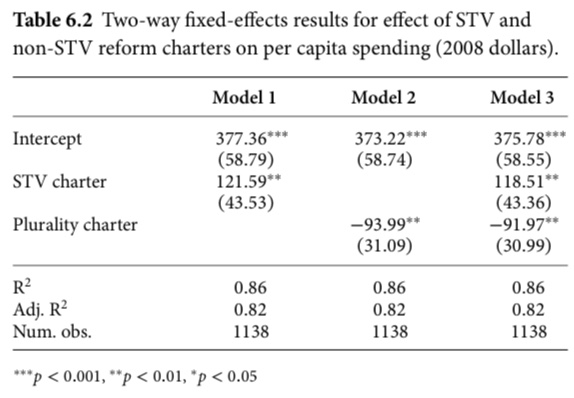
The takeaway is: higher aggregate spending under a council-manager charter that included single transferable vote (STV), compared to cities with non-STV manager charters, as well as cities whose ‘form’ of government didn’t change. I argue that this is to be expected, based on how the STV-manager charter combined the logics of “neighborhood representation” and “citywide focus” (both of which are common phrases in reform-practice circles).
The variety of reforms
Progressive Era municipal reforms came in three main flavors. One class strengthened directly elected mayors relative to local assemblies. It is not common to call this a “reform charter.”
Two more inaugurated the infamous ‘at large’ election. (On infamy, see Trebbi et al. 2008 or this new paper by Grumbach et al. 2023.) These also seem to have reduced the sizes of local assemblies.
One of them, the commission form of government, attempted to hold citywide elections to a series of functionally defined offices. Over time and to varying degrees, this morphed into a ‘numbered post’ electoral system. My former research assistant Andrew Rosenthal and I found nearly 100 such cases that came with an early form of ‘instant runoff.’ It is clear from historic advocacy materials that popular interests in preferential voting and more businesslike administration reinforced each other in helping commission government to spread.
The second at-large charter was designed, in part, to be compatible with some form of proportional representation (PR). It also aimed to piggyback on the joint popularity of preferential voting and businesslike administration. This was the council-manager form of government. It achieved compatibility with PR by junking the numbered posts.
Recent research
Two recent papers supply the impetus for this post. One from Carreri et al. (2023) finds limited effects on a range of inequality measures (pp. 13-14) from at-large-charter adoption, 1900-40. Another from Sahn (2023) disaggregates the two reform charters and points to greater capital outlays, 1900-34, from council-manger adoption. This is important; recall the “citywide focus” that council-manager is said to promote. (Also see Hankinson & Magazinnik 2023 on housing policy under at-large elections.)
There probably are other recent papers. I do not follow the historic urban political economy literature as closely as I might. I got to the topic by trying to say something about the effects of the reform I was studying (STV as embedded in a municipal reform charter).
Party competition in nonpartisan elections
My analysis used the data from this paper and focused on the period from 1930-60. This is important because, in 1932, the National Municipal League (NML) formalized the following policy: urge local reformers to form a “good government” party in any city where NML also was promoting council-manager. So, when we estimate the spending effects of these institutions, we may be picking up effects of the styles of party coordination they engendered.
It is worth noting that the new STV-manager charter in Portland (OR) once again has local reformers figuring out how to organize slates.
I argued that STV’s collision with a reform charter should lead to higher per-capita spending than non-STV charters and the absence of reform. The reason is that STV turned “good government” slates into “parties of neighborhoods.” The openness of an STV election made it unwise for reformers (now seeking to control government) to ignore (or harm) any given neighborhood. Evidence that politicians were thinking along these lines appears in the chapter. It includes first-choice vote shares by ward (when available), stories about campaign strategy, and stories about legislation (spot zoning, holding up slum clearance, etc). There also is a comparative literature on “localism” in STV elections (see, e.g., Carty 1981 on Ireland).
Here is the key table. “Plurality charter” really means “non-STV manager charter.” Unreformed city is the reference category. What this means is that the data do not record a change in form-of-government.
What we see above may combine what I’ve said about STV, plus the capital-outlays finding from Sahn.
The data in the other papers is better than what I used. Diff-in-diff also went into convulsion as I was writing my chapter, so I fell back on two-way fixed effects. I also did an RDD with pre-1930 data at one point, and that turned up no effects.
It has been two years since I finished/sent in More Parties or No Parties. Three issues with the theory have been on my mind. To recap, the theory says that “reform is common in periods of realignment” (or something along those lines). Then it says that a reform episode can be any of three types: insulating (comes from incumbent coalition), realigning (out-of-power folks peel off portion of incumbent coalition), and polarizing (opposing sides collude). The types were strictly internal to the polities whose institutions they were changing (cities for me, countries and some states for the lit review).
I do not have a thesis statement. I am making a list and riffing on it.
The first issue concerns coalition shift in general. I had cast this as resulting from activation of a coalition’s internal disagreement(s). Might not the addition of new players also destabilize a party system? (I think I acknowledged this possibility in a footnote.) Or might not the emergence of new issues do the same? I am thinking here of climate change especially, which is a ‘shock’ par excellence. It also has all sorts of implications for the issues that otherwise define the ‘basic space’ of a party system. What do we do when the ocean swallows the Outer Banks of North Carolina? Move the rich? Move everybody?
Another issue concerns the trigger(s) of a ‘realigning’ reform episode. Does the reform cause realignment, or does realignment cause the reform? The book argues that realignments cause reform, but a ‘realigning’ reform brings about (facilitates) realignment. So, which comes first? I suggested in ch. 8 that coalition shift at a higher level of government might produce demand for a realigning episode at some lower level. That would help to integrate other accounts of the reform adoptions I studied. For example, one good BA thesis argued that the Worcester reform charter was a business-community reaction to the rising power of the Irish — an insulating episode in my typology. I suggest it’s not this simple; the reform coalition included many people (Democrats) who helped elect a Mayor on the same day they ratified a charter meant to destroy his party. The key questions for me are about the magnitude and rapidity of change in advance of the reform. How big had the local Democratic Party gotten, and why? Maybe it comes down to an expanding set of salient issues, regardless of whether that’s at a higher level of government. I did find suggestive evidence with respect to unions. Maybe these are the same thing, at least sometimes.
Hopkins’ (2018) theory of nationalization is something I wish I’d brought in. Nationalization (as I integrate it into my mental model) means that higher-level cleavages are reshaping lower-level party systems. Or, in terms that are closer to those of Hopkins, national-level issues are more salient (for most people) to local politics than local-level issues. This leads (in my mind) to ‘oversized’ parties in some places, so that basic economic issues get debated within the oversized party. Witness non/bipartisan claims about corruption and how to pave a street.
Moving on.
I’m also not thrilled with having cast New York City (1936) as a ‘realigning’ episode. I am not saying this was wrong. The complication was the local separation-of-powers system. At the time of the reforms, Tammany controlled the Board of Aldermen, but LaGuardia controlled the mayoralty. And LaGuardia had won (and presumably controlled) a citywide vote majority.
So, maybe, the NYC reform was about creating congruence of control between the branches of government. (What the NYC reform package did to legislative power is fascinating, but let’s save it for another day.) Here is the article one might cite, then the key line: “Politicians became advocates of direct democracy, we argue, only where they were confident that voters were likely to agree with them and where current institutional arrangements blocked the median voter’s influence” (emphasis mine). Another way to put that: existing institutions (like malapportionment) were stopping statewide majorities from translating that strength into seat shares. That article is about different reforms, but the theory seems helpful. I also wonder if the identity/priorities of the ‘median voter’ changed in the period under our shared consideration (1898-1918). Otherwise, how would it have been possible to get around the incumbent coalition?
I updated some old graphs on U.S. House polarization last night. I did this because I use the measure as a ‘system sensing’ device. I also did it because I use the graphs in my classes, partly because students have heard of polarization — and therefore need to think critically about it.
There are lots of critiques of the polarization idea lately. I wrote a not-great one back in February 2021. I say “not great” because 90 percent of it conceded the terms of debate.
Here is one more full critique, which I highly recommend. I was honored to meet one of the authors at the 2022 APSA meeting.
Here is another. I include it on my Congress syllabus.
Now seems like a good time to remake some graphics I use often. All the underlying data are from Voteview.
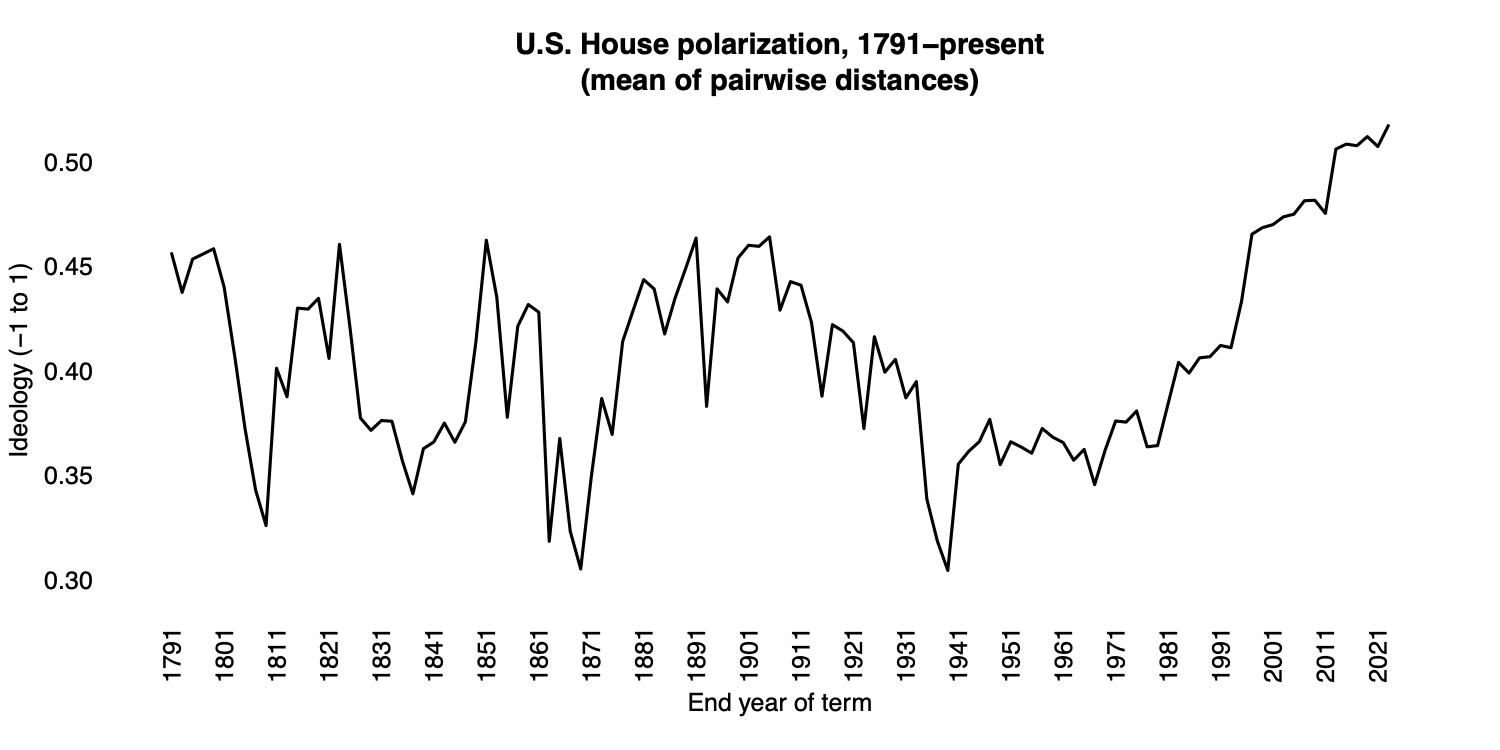
Below is a party-blind measure of polarization in the U.S. House, from the beginning of that chamber through Wednesday of last week. The party-blind measure is the mean of all pairwise distances. (I once calculated it here for states and first came across it here.) This lets us go back to before the major parties were Republicans and Democrats. It also does not force us to make arbitrary decisions about handling minor parties, independents, and others with less common ways of affiliating/identifying.
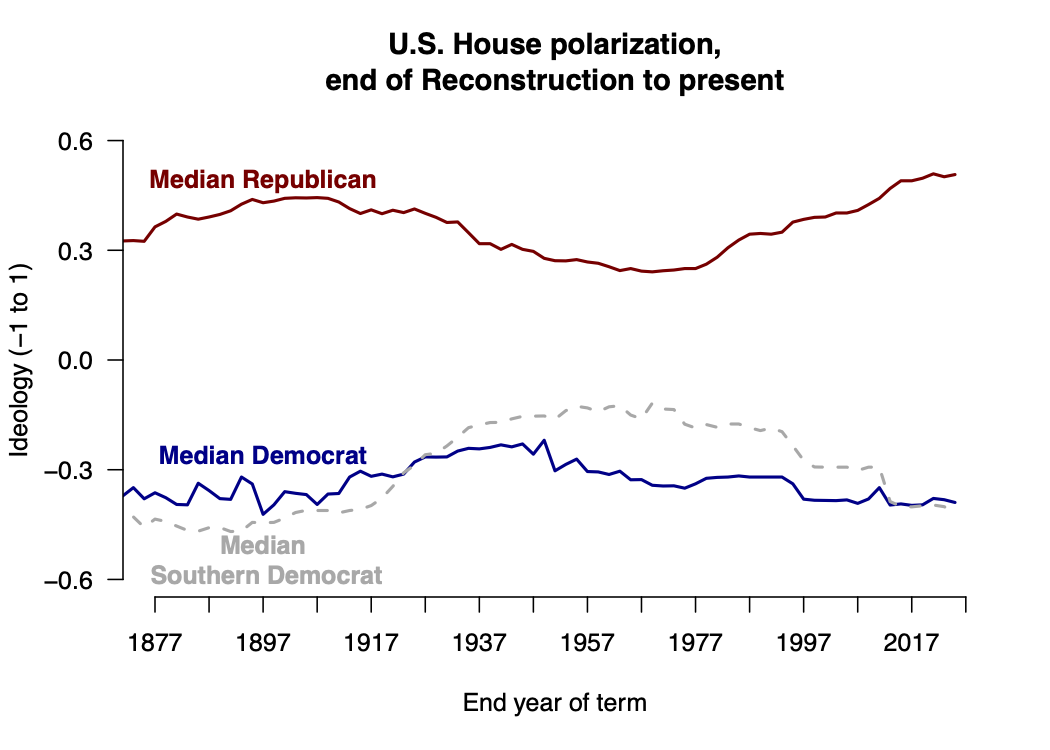
Below is the more familiar measure: distance between the median members of the major parties, back to the end of Reconstruction. This plot includes the median Southern Democrat (conventionally the 11 Confederate states plus Kentucky and Oklahoma).
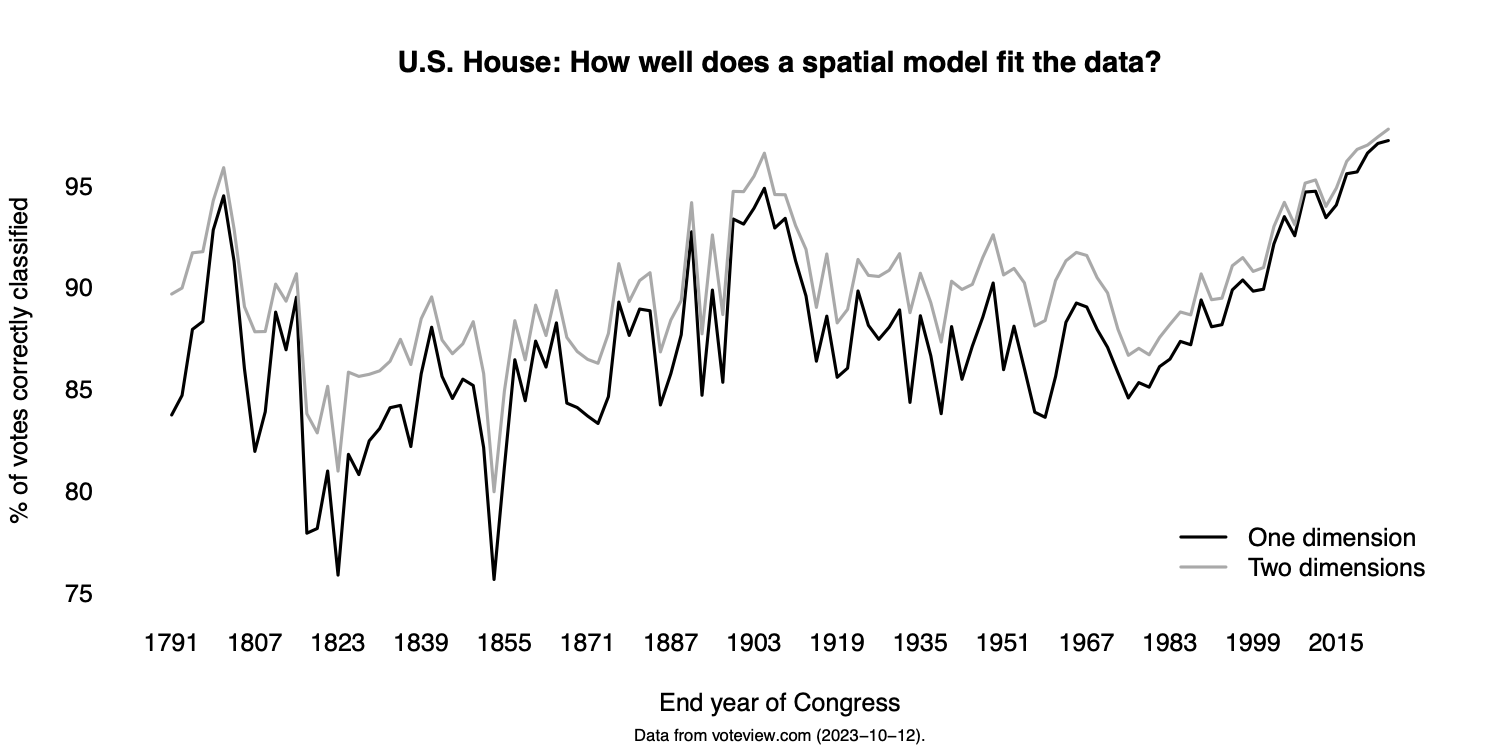
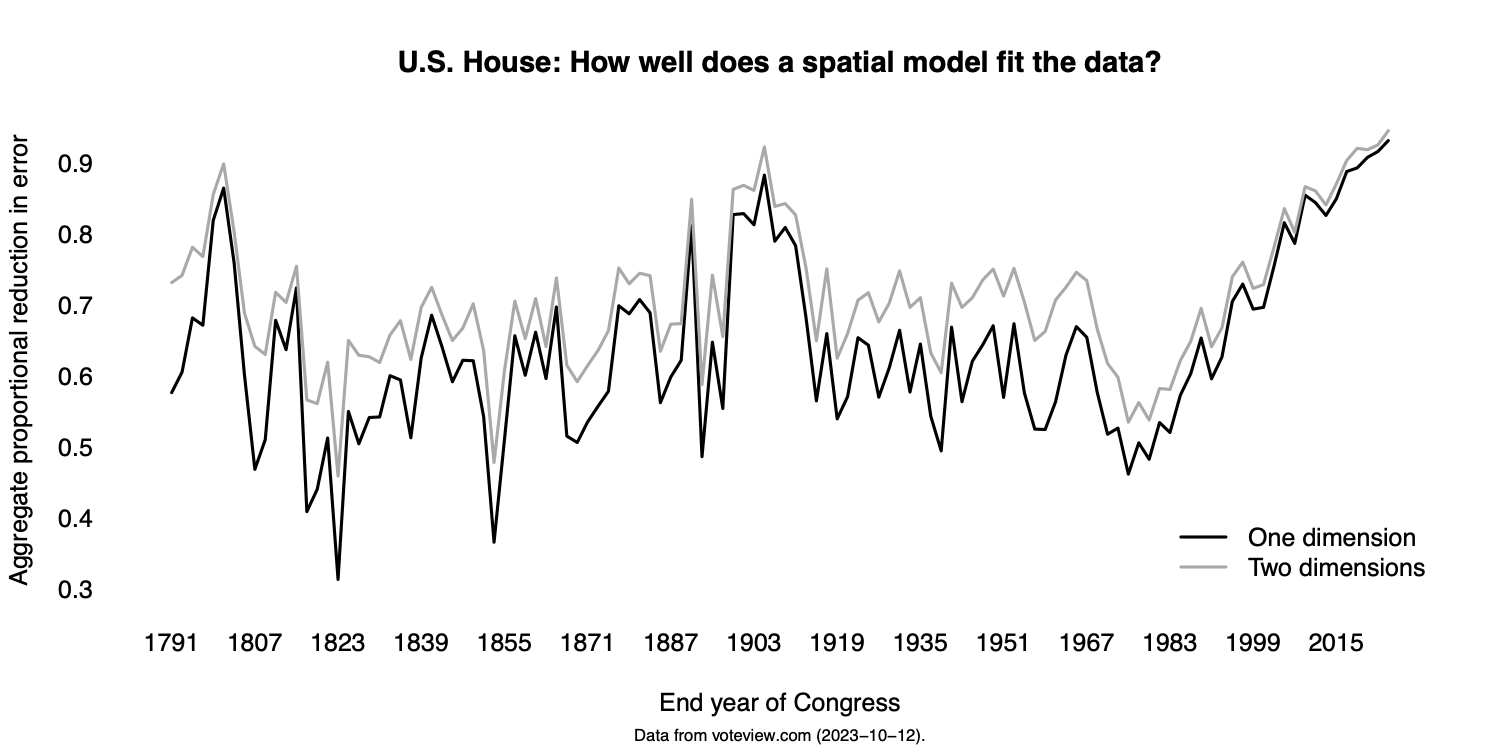
The last two plots answer the question: “How well does an N-dimensional model fit the data?” I used the optimal classification algorithm to recover ideal points for each House. I did this one Congress at a time; see here and here for other options. The black line comes from one-dimensional models. The gray line comes from two-dimensional models. The first plot gives the percentage of votes correctly classified, by Congress.
The second plot gives the aggregate proportional reduction in error.
Here is a CSV of the fit measures above. The first two columns are for the one-dimensional models. The next two are for two dimensions.