Skip to content

Origins of the term “winner-take-all”

Not all terms for describing electoral systems originated in political science. Some were developed (or at least popularized) by professional reformers seeking to build popular movements because legislative adoption was too hard. One of those terms is “winner-take-all.” Here is what F.A. Hermens says about it in written comments at the 1985 World Congress of the International Political Science Association.

Professor Longley makes some very perceptive remarks about factors which affected the demand for electoral change and the people who shaped it […] After an interval the energetic Enid Lakeman took over and intensified the work [of Humphreys]. She presided over a significant terminological change: The P. R. Society became The Electoral Reform Society, and the cause of reform was identified with that of P. R. Similar terminological changes were stressed: Calling plurality voting the “first past the post” system became more widespread, as did “winner take all” for majority voting. Thus the notion was conveyed that the former was as simplistic as the children’s game and the latter a grab for all there was. It is sad as well as significant that this terminology became frequent in academic writings; even the cautionary quotation marks are now all but gone.

By “majority voting,” Hermens seems to mean the two-round systems that tended to predate PR adoption on the European continent. “Majority voting” was a lifelong theme in his work.

However, in our own time, “winner take all” gets used to describe plurality allocation but not Alternative Vote (instant runoff). This inverts what Hermens observed 39 years ago about majority allocation. However, sometimes “winner take all” does get used to describe any system without multi-mark ballots. [Shrug emoj.]

(The term multi-mark comes from a 2019 book by political scientist J.S. Maloy. It is useful for alluding to the current range of proposed ballot types.)

Early exchanges like the above are fascinating because they were taking place alongside formation of APSA’s organized sections. They were shaping the scientific discourse of the decades to come.

That the terminological move began in Britain is not surprising. I have suggested elsewhere (p. 28, fn. 7) that non-list approximations of PR (like STV and cumulative voting) were all but fated to win the advocacy battle due to long-established traditions of party government in Anglo democracies. In short, reform in said democracies is prone to “rage against the machine.” That’s because incumbents didn’t — and maybe still don’t — need it to prevent coalition raids and/or shore up party discipline. On that, I recommend two papers. The first contains a short section on why early party government might close off what I call an insulating PR adoption. (These papers also cover the problem of coalition raids under Hermens’ preferred “majority system.”)

More on party government. It is not surprising that Hermens piggybacks on Longley. The latter was a scholar of comparative legislatures. (Hat tip to Dan Smith at Penn.) Legislatures generally work more smoothly when organized by parties.

As for Lakeman, it also is not surprising that she led the terminological revolution. Lakeman (1903-95) would have experienced the Liberals’ replacement by Labour as one of the United Kingdom’s two leading parties. Her Wikipedia entry notes lifelong commitment to the Liberal (later Liberal Democratic) Party. Lakeman likely would have been looking for a way to raid the majors’ coalitions — possibly on transfers under STV. Here, it may be helpful to compare a 1990s U.S. Green or the present-day Forward Party.

Further reading: Malcolm Baalman on the origins of the term “first-past-the-post.”

Deliberative democracy and electoral-system reform

Can a deliberative mini-public change minds on electoral systems? Recent efforts in the U.S. and elsewhere have tried to do just that. (“Try” may be too strong because the goal, I think, is to put options before everyday people and let them reach their own conclusions.) The latest originated in Stanford University’s Center for Democracy, Development, and the Rule of Law.

I am not optimistic. I think parties/partisanship shape political culture to an extent that constrains the deliberative approach.

Here is some background. I am not an expert on deliberative democracy/mini-publics. However, with respect to my research area, the trend originated with two citizens’ assemblies in Canada. One recommended single transferable vote (STV) for British Columbia (BC) in 2004. Another recommended mixed-member proportional representation (MMP) for Ontario in 2006. Both proposals went to referendum (twice in BC’s case), but neither resulted in adoption. Yet these citizens assemblies’ presumably changed enough minds to result in proposals.

More background. The point of a citizens’ assembly is to wrest control of some agenda from the hands of incumbent politicians/party leaders. At least that is how I understand it in the context of my research area. In that area, incumbents are assumed to oppose all change. “Turkeys voting for Christmas” is a mantra in the electoral-system change literature. Americanists might be more likely to write “Turkeys voting for Thanksgiving.”

Two countries’ experiences with DD inspired this post. James Traub recently reported on them in Democracy Journal. (The editors ask good questions, as I learned last summer.) Here are the key quotations:

Earlier this year, the South Korean parliament, deadlocked on a series of electoral reforms, authorized a [deliberative] poll on the subject. South Korea elects members of parliament through both single-member districts and proportional representation. After hearing arguments on both sides, the participants proved vastly more favorable to proportional representation than they had been in pre-deliberation surveys.

Now for the United States:

As they talked their way through the proposals, the group gravitated toward those that seemed most likely to reduce polarization, like nonpartisan primaries. “Let’s just vote the human being,” Brian said. They were flummoxed by unfamiliar ideas like fusion voting, which allows a candidate to run on more than one ticket and make common cause with other parties, and proportional representation, in which voters choose multiple winners for large, multimember districts.

These excerpts suggest big difference between the countries’ respondents with respect to what I might call “pro-party” reform. More precisely, the countries’ respective mini-publics appear to differ on reforms that treat political parties as bargaining units. South Koreans liked proportional representation. Americans were “flummoxed.”

I am not surprised. One thing I wrestle with is whether certain reforms are impossible in the United States, full stop. That’s because ‘Republican’ and ‘Democrat’ are fundamental to the way Americans understand politics and process (filter) political information. In turn, that leads (allows?) elites to shape the debate in certain ways. Here is part of what I wrote on the issue in More Parties or No Parties (p. 47).

Whether a reform is party-hostile or -hospitable depends on the composition of the reform coalition. It can comprise a single party, multiple parties working together, or a coalition that defies party lines (i.e., is cross-party). The pre-existing number of parties limits which of these are possible. In a two-party system, a cross-party coalition must be anti-party, unless it is a polarizing one. Consider recent data on public views of reform [in the U.S. and elsewhere]…

Thanks to Gary Morehead (on X) for arriving at the same conclusion using different information.


My current thoughts on PR/“more parties” reforms

What follows is mainly for me, but maybe it is useful.

I would view list-PR adoption as an ‘insulating’ action by a coalition that is hard but not impossible to put together. The same would go for national/widespread imposition of ballot fusion (also see first link).

I am wary of efforts to promote PR for its own sake.

I think we are going to see (or at least hear about) more reform activity than usual in cities and maybe some states. It would be nice to see this go in the “more parties” direction.

I prefer to say “pro-party.” I don’t think that direction has to alter the party system by, say, causing lots of parties to win seats in Congress or run presidential candidates.

Even locally, I am reluctant to say it would be easy to build a pro-party reform coalition.


How much should we focus on the number of parties?

Two motives currently define demand for a system of proportional representation (PR). One is to increase the number of parties. Another is to bring parties’ seat shares closer to their vote shares, regardless of how many parties there are.

Two motives accordingly define opposition to PR. One invokes governability issues from an increased number of parties. The other, which we do not hear in public, is that PR would benefit the party (coalition) whose voters concentrate in population-dense areas.

So, one flavor of opposition and one flavor of support share a premise that PR increases the number of parties. This short post aims to share some data on the validity of the premise. What I take from these data is in line with something I wrote last summer: “the current conversation is too focused on the number of parties.” By that I meant both opposition to and advocacy of PR.

Below are some data from Calvo (2009). (I would include the link if I could find it.) That paper argued that districting considerations — not a desire to improve representation — are fundamentally responsible for PR adoption in Western Europe.

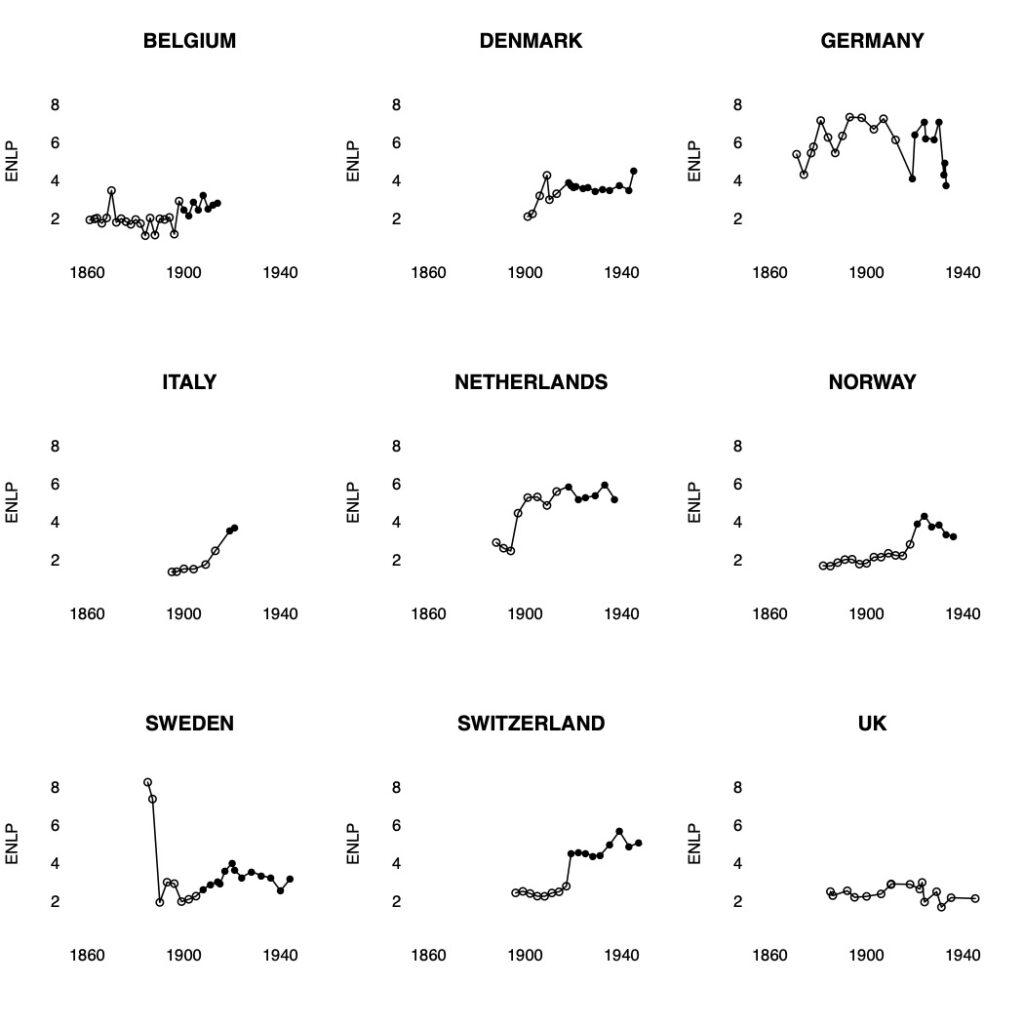
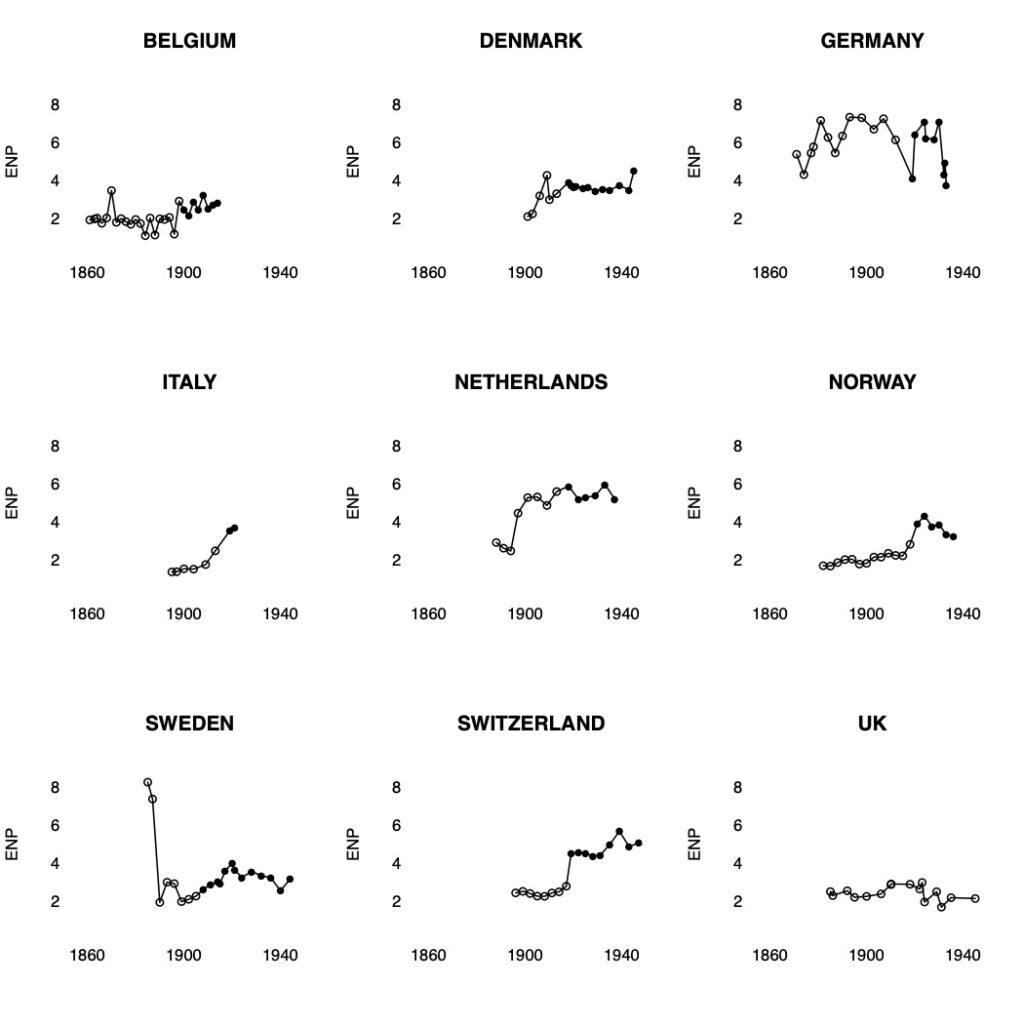
Our first set of graphs focuses on the “effective number of [electoral] parties” (ENP) in lower chambers. In these graphs, an empty data point is an election without PR, and a filled data point represents an election under PR. As a benchmark, ENP in United States House elections typically is within 0.1 of 2.0. ENP tells us what voters are doing, possibly but not necessarily in response to PR adoption.

The graphs above show increases in the number of parties in advance of PR adoption— but not mechanically and not in all cases! Also, only one case shows a proper post-PR ‘jump’ in the effective number of electoral parties: Switzerland. I argue elsewhere that this is because the Swiss PR adoption was a ‘realigning’ episode, made possible by prior adoption of nationwide initiative-and-referendum. Lutz (2004) thus calls the Swiss PR adoption “reform from below.”

Bottom line: the number of parties may have mattered but not in the way some argue: things ‘pressing’ for and being given representation. Rather, and channeling Calvo (2009), multiparty politics made it so that majoritarian electoral rules could no longer be relied on to deliver majoritarian outcomes. Here is a stylized story for any of the above plots except Switzerland (again, reform “from below”). Dealignment, possibly due to an influx of new voters, begins putting pressure on incumbent party leaders and legislators. They debate what to do for a while. Then they conclude that the best way to hang onto power might be to adopt PR.

Here are data on the “effective number of legislative parties” (ENLP), or the size-adjusted number of parties actually in the legislature. They do not look very different from the data on ENEP.

Both measures suggest that PR does not much affect voting behavior, at least in the short term. In turn, this suggests that PR probably does not do much to harm governability. Rather, in a world where governability matters, PR adoption more likely stems from a desire to preserve “governability” — by the coalition adopting it!

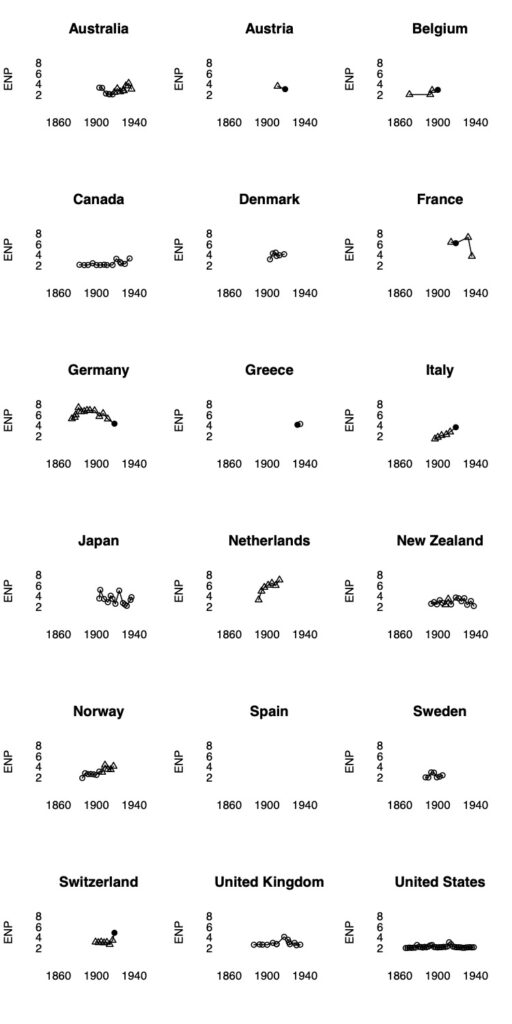
Below is one more look at ENP, this time with data from Blais, Dobrzynska, and Indridason (2005). This look includes the Anglo settler democracies, which many readers will want to see. Here, a filled dot represents the first election under PR. An empty dot represents an election under plurality, and an empty triangle represents an election under strictly majoritarian rules (runoff, Alternative Vote). The key thing to note, especially for the Anglo democracies, is that an increase in the number of parties does not mechanically cause PR adoption. Other things are going on.

We are at a point when many people like the idea of PR. More precisely, many have become comfortable with, if not supportive of, an increased number of parties in the United States. (That is a sea change from when I entered this research area.) I agree that under certain circumstances, multiparty politics with PR is a good idea. My point is that the number of parties gets more attention than it should — as a threat to governability, as a ‘stepping stone’ to PR, and maybe as an end in itself.

What matters more than the number of parties is that majority coalitions, be they single-party or alliances of parties, can win majorities of legislative seats and then hold themselves together between elections. (I am nearly plagiarizing myself, except that I am citing myself.) If those ideas sound good, you want two things: a system of proportional representation, then one in which a party’s leaders have the tools to discipline their rank-and-file.