I made big progress today with a nasty data import that I’ve been working on for the last four months! Now is accordingly a good time to introduce a topic I’ll cover a lot on this blog. In a chart:
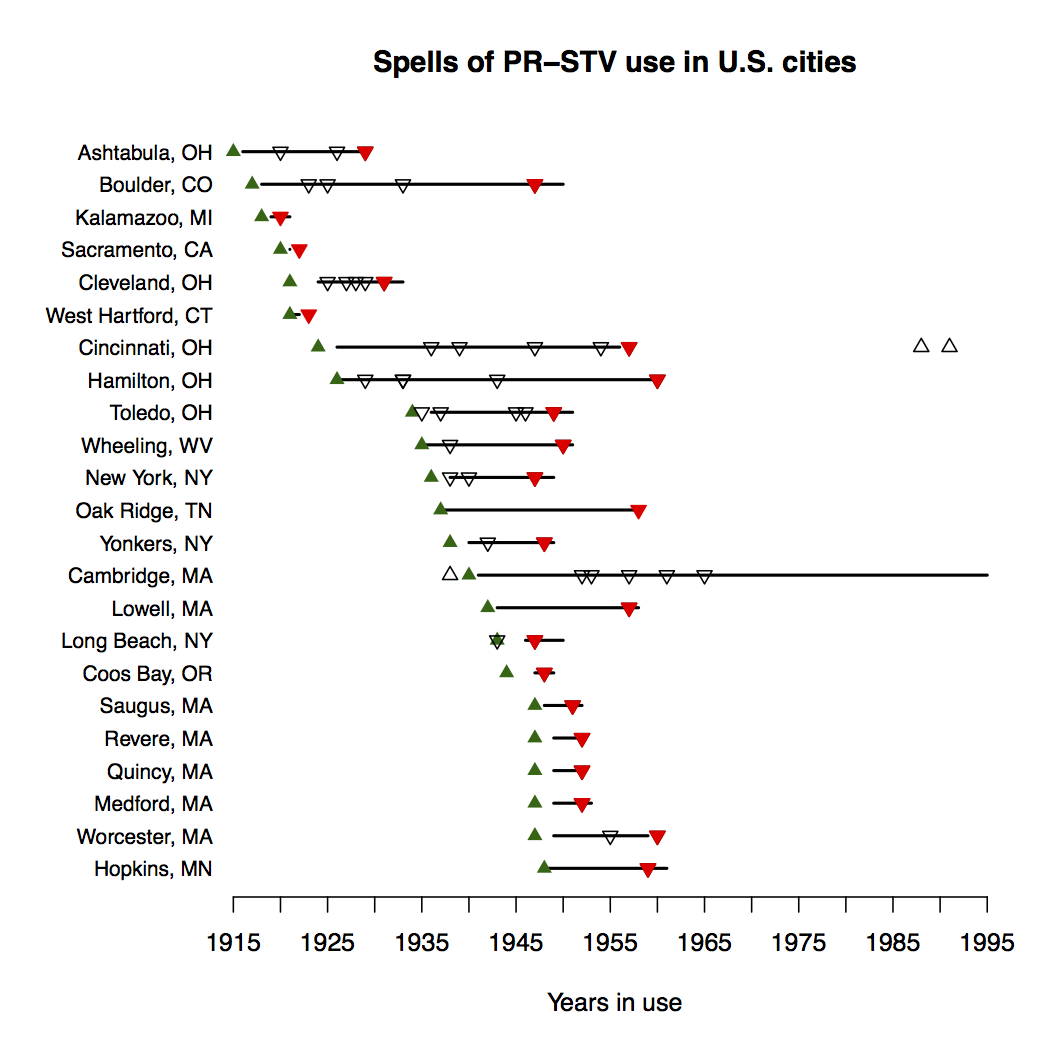
What you see there is a list of twenty-four incorporated municipalities that used, for public elections, proportional representation through the single transferable vote (PR-STV). Green, upward arrows indicate successful adoption efforts. Red, downward arrows indicate successful repeal. Empty arrows indicate unsuccessful adoption and repeal efforts. The black bars represent the years that PR-STV was actually in use, not simply on the books.
Here is the spatial take on the same set of towns:
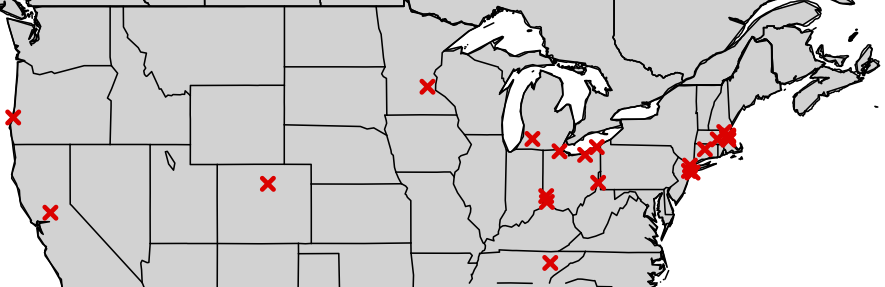
One could list other instances in non-incorporated places or where elections did not determine the identities of formal decision-makers. One might also dispute the inclusion of Norris and Oak Ridge, Tennessee, which were federally planned and administered during the Great Depression (of 1929) and World War II, respectively.
Twenty other towns and cities in Canada also used PR-STV, and Dennis Pilon has analyzed those experiences. An earlier plan for my research incorporated these cases, so I may say more about them later. Overall, though, the Canadian PR adoptions all happened during or right after World War I. Those that did not almost immediately repeal PR retained it into the 1960s-70s (Edmonton, Alberta and Winnipeg, Manitoba).
The literature on these episodes usually treats them in isolation, both from each other and from other kinds of urban institutional change. That tendency precludes some interesting observations.
First, PR came in all U.S. cases (except New York City) as part of an otherwise restrictive reform package. By shrinking councils, moving to at-large elections, depriving voters of party labels, eliminating elected mayors, and organizing so-called non-partisan slates, Progressive reformers aimed to monopolize political power. Taken in the context of that broader package, replacing plurality at-large with PR of any type represents a major deviation. PR makes it easier, not harder, to win office. What, then, was going on in these two-dozen of the hundreds of cities to adopt reform charters? More than likely, PR was the price that reformers paid for some portion of their referendum majorities.
Now, the observation that some urban reformers had to pay the PR price highlights an obvious cleavage among Progressives. So does the Presidential election of 1912, the high-water mark for Progressives in national politics. In that election, Teddy Roosevelt took twenty-four percent of votes, and Eugene Debs pulled off six percent for the Socialist Party. As Rosenstone and company note, Socialists comprised the thorniest ever minor-party challenge in American history. Getting them to agree with the other Progressives on (ex-Republican!) LaFolette in 1924 took effort. I suspect that same cleavage was at work in the PR cities’ reform movements. If you want an image of that, picture Republican Mayor Fiorello Laguardia making policy alongside a PR-elected city council containing capital-C Communists.
So, if I’m correct, national party politics were contaminating local politics. Or, rather, all politics really is local. That is because most political headaches are born among few people in a single room somewhere. Right around the time that U.S. cities really started taking PR seriously, some European countries adopted it for national elections. According to one prominent argument, that national trouble began in towns and cities run by liberal-labor coalitions, just as the 24 U.S. cities were run.
Running with the U.S.-Europe comparison for a moment, we might claim that Progressivism had right and left wings. Its right wing was the analogue of a European liberal party, and its left was, well, we just covered that. Both forces emerged in response to economic transformation. Liberals sought efficiency gains from technocratic governance, and socialists wanted better lives for the folks on the bottom. (Let’s set aside the problem of getting farmers to play nicely with workers, which also existed in Europe.) Seen from this perspective, the patronage-based parties of the Third Party System start to look a lot like the proto-modern conservative parties of Western Europe, including their internal divisions between aristocracy and business.
Since we are now discussing capital-P, capital-S Party Systems, I’ll conclude with a thought on periodization. According to the main interpretation of U.S. party history, 1896 saw the political triumph of industry and emergence of two regional parties. Only one Democrat (Woodrow Wilson) would become President until 1932, and he did it in a four-way election with the backing of his party’s conservative wing. In the meantime, turnout fell to present levels, and minor parties proliferated. Post-1932, third-party voting declined, and the two-party system we know and love came into being.
That narrative hangs together until one considers that fifteen of the twenty-four PR towns adopted their PR rules in or after 1935. Pending something more rigorous, a spot-check of county-level election returns suggests that the same partisan culprits were on the scene well into the 1950s.
Duverger observed that single-seat plurality rules tend to coincide with two-party systems. He speculated that this was because those rules present incentives to vote for frontrunners. That is probably true in the literal sense of “probably.” The interesting thing is who controls the rules. PR’s repeal happened in twenty-three of the twenty-four cases. Those were successful efforts to regain control of the rules. Did those constitute an effort to construct a two-party system? Or were they something else? I’ll have more on that and other stuff later.
1 comment on “Proportional representation in U.S. cities”