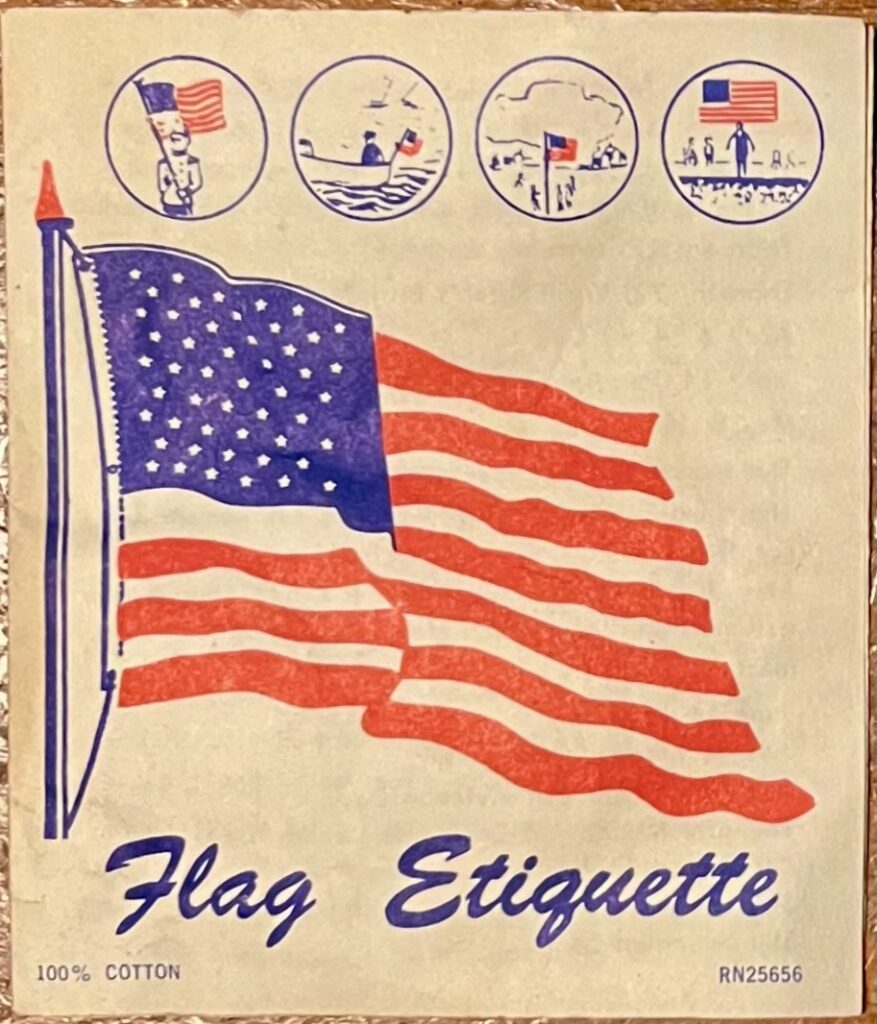
Here are the instructions that came with an American flag I own. It is 100% cotton and was new-in-bag when I got it. The packaging suggests it was manufactured in the early-to-mid-1960s.
Here is the text:
On the following days the American Flag should be displayed:
January 20, 1961, and every fourth year after that, as that is the day that the President is inaugurated.
February 12, Lincoln’s Birthday.
February 22, Washington’s Birthday.
April 6, Army Day.
April 14, Pan-American Day.
May 8, V-E Day.
The second Sunday in May, which is Mother’s Day.
The third Sunday in May, which is I-Am-an American Day.
May 30, Memorial Day, when the flag should be half-mast until noon, then after that it should be full-mast.
June 14, Flag Day.
July 4, Independence Day.
August 19, National Aviation Day.
The first Monday in September, Labor Day.
September 2, V-J Day.
September 14, anniversary of the writing of “The Star Spangled Banner.”
September 17, Constitution Day.
Last Sunday in September, Gold Star Mothers’ Day.
October 12, Columbus Day.
October 27, Navy Day.
On the Presidential Election Day or every four years, which is the first Tuesday after the first Monday in November.
November 11, Armistice Day of World War I.
The Fourth Thursday in November, Thanksgiving Day.COLOR MEANINGS:
RED – – – stands for hardiness and courage.
WHITE – – is the symbol of purity and innocence.
BLUE – – is the color of vigilance, perseverance, and justice.WHEN AND WHERE TO DISPLAY THE FLAG
On buildings and stationary flagpoles outdoors, the flag should be displayed only from sunrise to sunset. It should not be displayed at all during stormy or rainy weather, unless for some very special reason.
In no case should it ever touch the ground. It should be raised with hearty briskness, and when lowered, it should be done solemnly and slowly.
THE BLUE FIELD WITH THE STARS IN THE FLAG should be at the peak of a staff extending from the building front, balcony or window; and next to a pole when extended from a house to a pole at edge of sidewalk and suspended by a rope.
When the flag is displayed horizontally or vertically flat against a wall or similar place, the blue field must be at the left of a person facing it; this is also true when used on a speaker’s platform. It must also be above and behind the speaker if placed flat. However, if the flag is flown from a staff, it is placed at the speaker’s right.
When the flag is displayed over the middle of a street, it is suspended vertically. The blue field points north in a street running east and west, and it points east in a street running north and south.
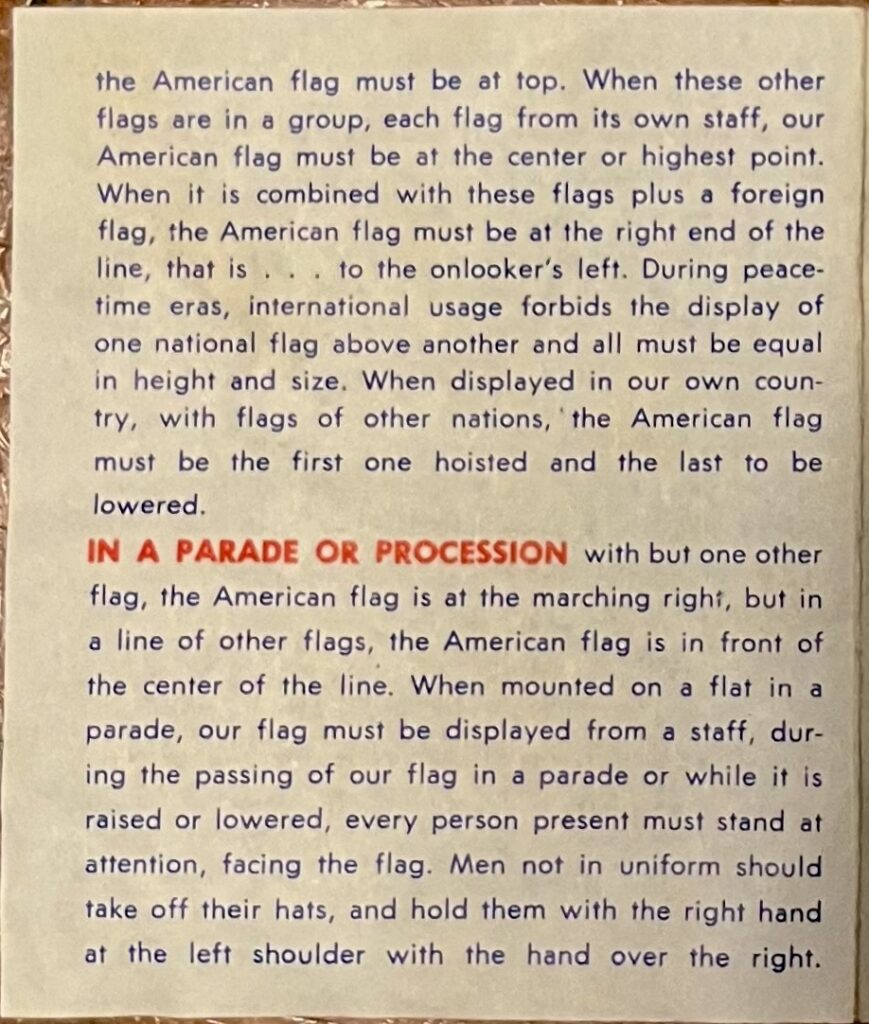
WHEN THE AMERICAN FLAG IS CROSSED AGAINST THE WALL with another flag, our flag is on the observer’s left and the staff crosses in front of the other flag. When it is flown on the same halyard (rope) with flags of States, cities, societies or clubs, the American flag must be at top. When these other flags are in a group, each flag from its own staff, our American flag must be at the center or highest point.
When it is combined with these flags plus a foreign flag, the American flag must be at the right end of the line, that is . . . to the onlooker’s left. During peacetime eras, international usage forbids the display of one national flag above another and all must be equal in height and size. When displayed in our own con-try, with flags of other nations, the American flag must be the first one hoisted and the last to be lowered.
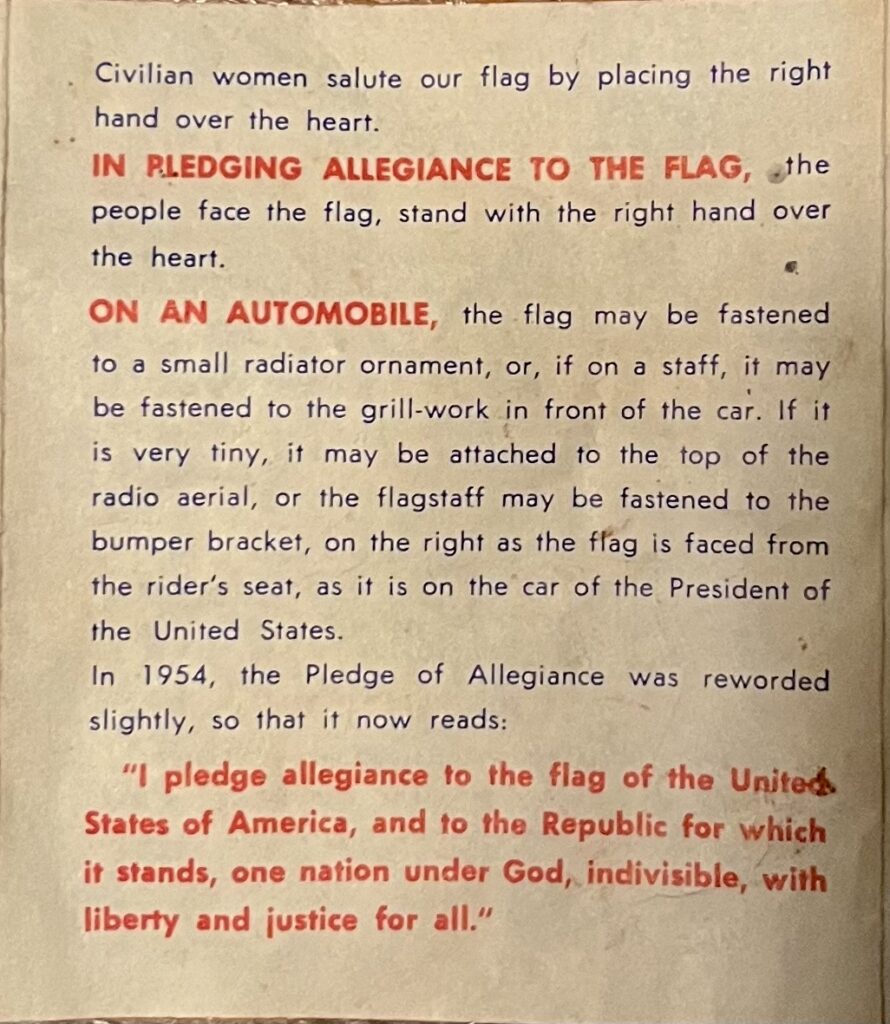
IN A PARADE OR PROCESSION with but one other flag, the American flag is at the marching right, but in a line of other flags, the American flag is in front of the center of the line. When mounted on a flat in a parade, our flag must be displayed from a staff, during the passing of our flag in a parade or while it is raised or lowered, every person present must stand at attention, facing the flag. Men not in uniform should take off their hats, and hold them with the right hand at the left shoulder with the hand over the right. Civilian women salute our flag by placing the right hand over the heart.
IN PLEDGING ALLEGIANCE TO THE FLAG, the people face the flag, stand with the right hand over the heart.
ON AN AUTOMOBILE, the flag may be fastened to a small radiator ornament, or, if on a staff, it may be fastened to the grill-work in front of the car. If it is very tiny, it may be attached to the top of the radio aerial, or the flagstaff maybe fastened to the bumper bracket, on the right as the flag is faced from the rider’s seat, as it is on the car of the President of the United States.
In 1954, the Pledge of Allegiance was reworded slightly, so that it now reads:
“I pledge allegiance to the flag of the United States of America, and to the Republic for which it stands, one nation under God, indivisible, with liberty and justice for all.”