Skip to content

Legislative implications of current anti-party reforms

Following up on yesterday’s post, here is a brief statement of the legislative reason for the repeal of the single transferable vote in US history. I have no reason think it would not apply to instant runoff as well. Both are fundamentally STV, and both are being promoted as a way to break up parties.

I have written elsewhere that STV opened the possibility of ‘vote leakage.’ Leakage usually refers to votes cast for one party but that help a different one win seats, via the transfer process.

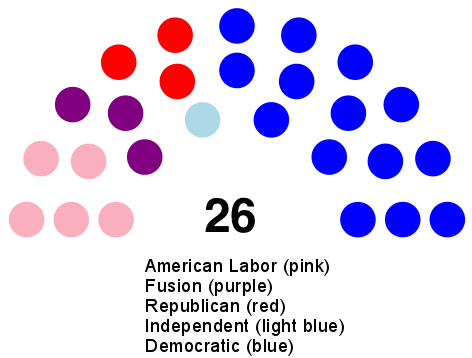
Connecting this phenomenon to STV repeal required tracking leakage between coalitions, not among parties. New York City illustrates the logic. There, votes were expected to leak among a series of anti-Tammany parties.

Apportionment diagram of New York City’s first STV-elected council, November 1937. Source: LSE USAPP, December 2016.

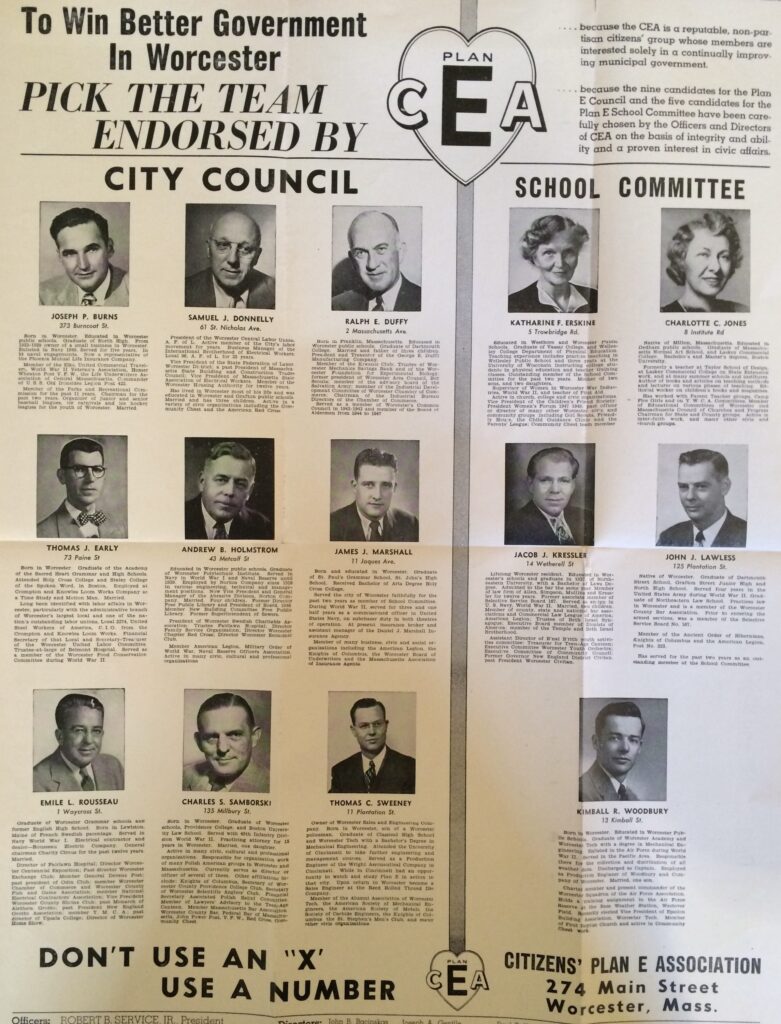
In other cases, local parties were formed to keep votes away from the rumps of parties displaced by the reforms. This was a direct response to problems organizing STV-elected legislatures.

Slate mailer from Worcester, Mass., early 1950s. Source: author’s archival research.

It didn’t work in the long run. Below is my go-to image for introducing people to the problem. It gives the percentage of roll-call votes in each legislative term on which some portion of said local party (Citizens’ Plan E Association or CEA in this case) teamed up with the opposition and thus defeated its own party’s position. This is known as a majority roll when we focus on the majority coalition, which the figure does. The link between the roll rate and STV repeal is clear. Chapter 7 here gives a detailed account of this and other such episodes, linking them to vote leakage as well.

Source: chapter 7 of More Parties or No Parties.

Here’s why this is an issue for advocates. Let’s say the point of current reforms is to bring Republican moderates into coalition with Democrats. That would be analogous to the reason for the CEA above. What the graph shows is the reform failing to bind that coalition. It shows the reform eventually doing the opposite of what it was supposed to do.

This is one reason why I recommended party-list systems and maybe ‘fusion voting’ instead of STV and its derivatives. (Others have been equity and ease of implementation.)


Early thoughts on the new book “The Primary Solution”

Nick Troiano’s new book is an engaging read. Here are a few thoughts with the caveat that I am still working through it.

1. With Gehl and Porter (2020) it argues for the jungle primary as a way to “fix to our political dysfunction […] without the unlikely passage of new federal laws or constitutional amendments.” So, we are asked to accept the premises that federal-level electoral-system change is a no-go… or at least a long time off… requiring state/local demonstration cases.

2. Readers are assumed to agree that “our political system is broken.” It’s clearly not working well right now, but that could change. I have pressed this point a few times with ‘primary reform’ backers — realignment itself is a path ‘out.’ That would be a case of our so-called Madisonian system doing what it was expected to do.

3. Do benefits of the proposed reforms therefore outweigh the costs? I am not a fan of utilitarian moral reasoning, but I do appreciate that leaders sometimes have to engage in it. So, my last two points cover costs.

4. The book claims an absence of “any credible research” that RCV has disparate impact, in whatever terms, on communities of color. This is overly dismissive (at best). I encourage readers to come to their own conclusions after an hour or two with Google Scholar.

5. The book attributes to me (p. 137) the same conventional wisdom I sought to challenge with respect to STV’s repeal. So, two years’ getting and punching archival data into Excel seems to have left that debate where it was before the work began in 2014. Addendum: here is what I actually argued.

6. There are a few invocations of the one-dimensional spatial perspective. That is to be expected in a work of advocacy. It might even be expected when political scientists get called on to redesign institutions. Analytic work on electoral reform, however, has been moving away from this perspective.

As I said, I am still reading, and the book is engaging.

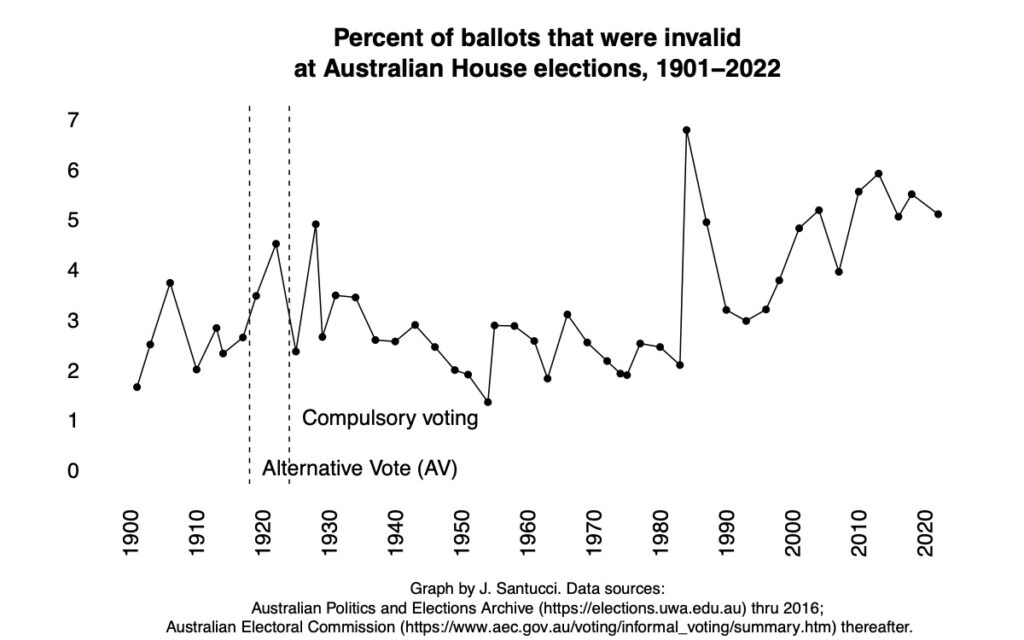
Ballot invalidity, Australian House of Representatives

This post updates a graphic I produced in June 2021. I have added data from the Australian Electoral Commission for 2018 and 2022, as well as a line indicating the adoption of compulsory voting.

Invalidity in recent years seems to hover around 5 percent. That figure is consistent with figures from research on the United States. Some of it is recent, and some of it is quite old.

Two potential explanations stand out: voter confusion and refusal to follow compulsory-ranking instructions (see especially p. 9 here).

Data for the graph are here. The data up to 2016 used to be available here.


Agenda control, NYC, early 1930s

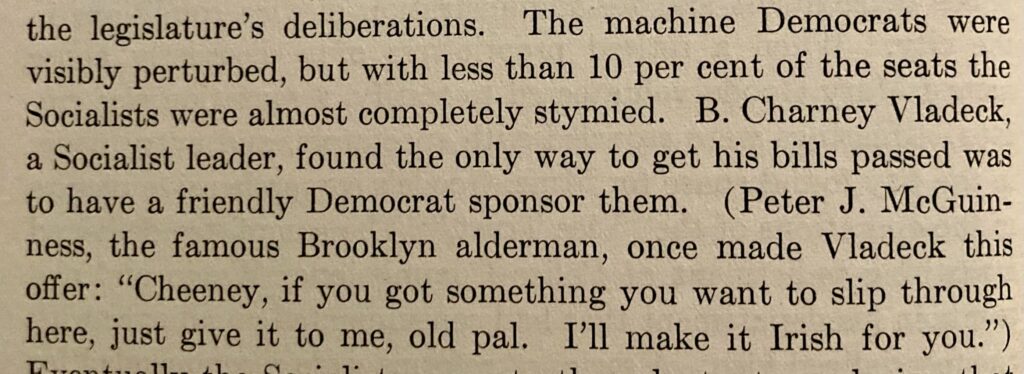
I was going through old photos and found this. It is from Shaw’s (1954) History of the New York City Legislature. What do you see in it?

Here is the text not baked into an image:

…the legislature’s deliberations. The machine Democrats were visibly perturbed, but with less than 10 per cent of the seats the Socialists were almost completely stymied. B. Charney Vladeck, a Socialist leader, found the only way to get his bills passed was to have a friendly Democrat sponsor them. (Peter J. McGuinness, the famous Brooklyn alderman, once made Vladeck this offer: “Cheeney, if you got something you want to slip through here, just give it to me, old pal. I’ll make it Irish for you.”)


Origins of the term “winner-take-all”

Not all terms for describing electoral systems originated in political science. Some were developed (or at least popularized) by professional reformers seeking to build popular movements because legislative adoption was too hard. One of those terms is “winner-take-all.” Here is what F.A. Hermens says about it in written comments at the 1985 World Congress of the International Political Science Association.

Professor Longley makes some very perceptive remarks about factors which affected the demand for electoral change and the people who shaped it […] After an interval the energetic Enid Lakeman took over and intensified the work [of Humphreys]. She presided over a significant terminological change: The P. R. Society became The Electoral Reform Society, and the cause of reform was identified with that of P. R. Similar terminological changes were stressed: Calling plurality voting the “first past the post” system became more widespread, as did “winner take all” for majority voting. Thus the notion was conveyed that the former was as simplistic as the children’s game and the latter a grab for all there was. It is sad as well as significant that this terminology became frequent in academic writings; even the cautionary quotation marks are now all but gone.

By “majority voting,” Hermens seems to mean the two-round systems that tended to predate PR adoption on the European continent. “Majority voting” was a lifelong theme in his work.

However, in our own time, “winner take all” gets used to describe plurality allocation but not Alternative Vote (instant runoff). This inverts what Hermens observed 39 years ago about majority allocation. However, sometimes “winner take all” does get used to describe any system without multi-mark ballots. [Shrug emoj.]

(The term multi-mark comes from a 2019 book by political scientist J.S. Maloy. It is useful for alluding to the current range of proposed ballot types.)

Early exchanges like the above are fascinating because they were taking place alongside formation of APSA’s organized sections. They were shaping the scientific discourse of the decades to come.

That the terminological move began in Britain is not surprising. I have suggested elsewhere (p. 28, fn. 7) that non-list approximations of PR (like STV and cumulative voting) were all but fated to win the advocacy battle due to long-established traditions of party government in Anglo democracies. In short, reform in said democracies is prone to “rage against the machine.” That’s because incumbents didn’t — and maybe still don’t — need it to prevent coalition raids and/or shore up party discipline. On that, I recommend two papers. The first contains a short section on why early party government might close off what I call an insulating PR adoption. (These papers also cover the problem of coalition raids under Hermens’ preferred “majority system.”)

More on party government. It is not surprising that Hermens piggybacks on Longley. The latter was a scholar of comparative legislatures. (Hat tip to Dan Smith at Penn.) Legislatures generally work more smoothly when organized by parties.

As for Lakeman, it also is not surprising that she led the terminological revolution. Lakeman (1903-95) would have experienced the Liberals’ replacement by Labour as one of the United Kingdom’s two leading parties. Her Wikipedia entry notes lifelong commitment to the Liberal (later Liberal Democratic) Party. Lakeman likely would have been looking for a way to raid the majors’ coalitions — possibly on transfers under STV. Here, it may be helpful to compare a 1990s U.S. Green or the present-day Forward Party.

Further reading: Malcolm Baalman on the origins of the term “first-past-the-post.”