I am deeply thankful to Todd Donovan for this review of my book. It introduces points I have not been able to cover in public-facing writing. These include parts of the theory, what happened with STV between its adoption and repeal, and the spending effects as linked to campaign strategy.
Like the book, the essay draws on the fields of urban and comparative politics. Todd’s own work on the topic is very much worth reading.
“Downward cascade” refers to a potential one-person-one-vote violation in the block-preferential form of ranked-choice voting (BPV). Ben Reilly introduced me to the term when we wrote this piece on BPV.
BPV aims to find the majority winner for each seat in a multi-seat district. It does so by breaking the election into “tabulations” — one for each seat. All votes from tabulation t proceed to t+1 and so on. The key word there is “all.” The winner of the first tabulation does not proceed to the second, but the votes that elected that person do.
So we say that votes can “cascade downward” from the first winner to others. This is not the same as a “transfer” in any of the other transferable-vote systems. Those transfers aim (in theory) to give each vote equal weight.
KPCW radio has a story on the outcome. Here is the key bit:
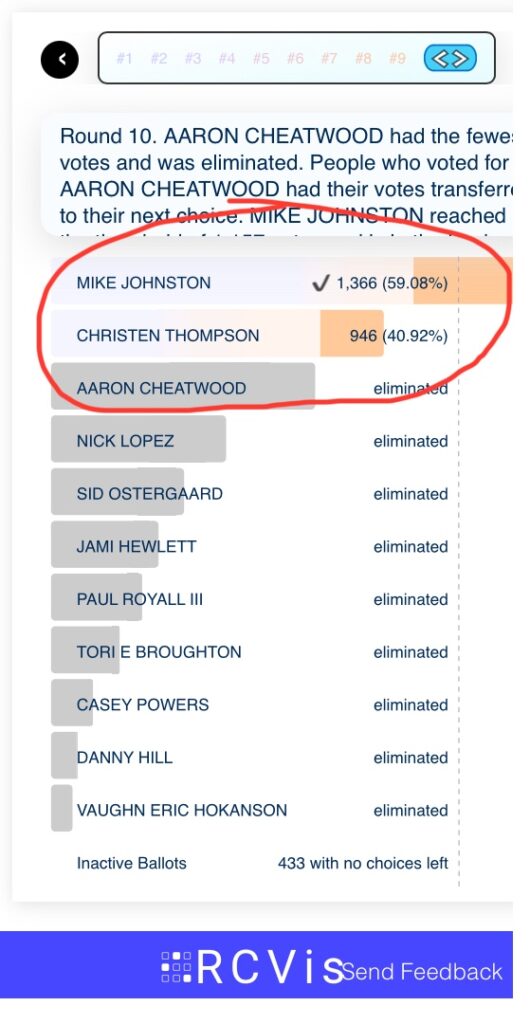
Candidate Christen Thompson ranked second in the race for each of the three city council seats, so he was not elected. While he said he’s disappointed, he still supports the ranked-choice system.
“I really like ranked choice, because it really gives people the chance to vote for what they believe in… without being afraid of losing their vote,” he said.
The city website lets us verify the district magnitude.
It also lets us see a BPV count in action. Pay attention to the final-round count in each tabulation. (It may help to follow the fate of Thompson above.)
The data suggest that downward cascade from Johnston and/or Cheatwood helped Ostergaard beat Thompson. Ostergaard was in fifth place at the end of the first tabulation.
Had the city used the “bottoms up” form instead (again see), the top three candidates from the first tabulation would have won the seats.
Alas, “bottoms up” is not popular with those who insist on theoretically majoritarian reforms. Nor is single transferable vote, since it is widely seen as (semi-)proportional.
Australian Senate elections were by BPV for three decades.
I recently wrote a post for 3streams on ten types on RCV. What sorts of campaigns might they engender?
The working assumption here is that two sides will emerge in politics. They may not track party lines, but they should be identifiable if one looks at the rightdata in a context where the system is ‘settled.’
To summarize the 3streams post, these systems can be used to try to get any of three things: single majority winners, majority-slate sweeps, or both sides represented in a multi-seat district. It is a bit more complicated than that, but this serves to introduce the ideas that follow.
“Anybody but X” campaigning and/or electioneering. Look for this in STV and maybe AV/IRV when they are working ‘well.’ Laver (2000) pointed to this logic in a chapter on government formation.
Slate formation. Look for this in any of the multi-seat systems. Savvy candidates would want to benefit from their “vote pooling” properties. Maja Harris has been following this in Portland (OR).
Spread-the-preferences (STP) strategies. This term is from the comparative literature. It means optimizing two imperatives: run a number of candidates that can win, and ensure a more-or-less even distribution of their first-choice votes. Neighborhoods are therefore good for recruiting candidates, doing GOTV, and possibly targeting policy benefits. Watch for STP in STV and bottom-up. I need to think more about BPV. I don’t see it as a factor with numbered-post.
Fragmentation in primaries. I need to think more about this. One, running for a nomination often is not the same as running to win power. Two, that is what our best source on the history reports. Three, most papers on “exhaustion” (IIRC) point to non-majority winners emerging from fragmented fields. Four, the game theory I have seen suggests that candidates appealing to the same group of voters may not have an incentive to encourage ranking (among other issues).
Nonpartisan primaries (so-called). I have no clear prediction beyond “anybody but X.” And yet there is the game theory I just mentioned.
I may update this later. Thanks to HB for the suggestion.
There has been a boom of late in estimating the policy effects of historic local-government reforms. Those were often tied to forms of preferential voting. I want to share what I found when I did my own study of spending effects.
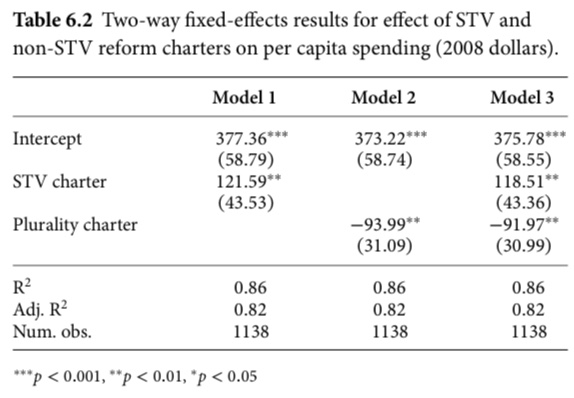
The takeaway is: higher aggregate spending under a council-manager charter that included single transferable vote (STV), compared to cities with non-STV manager charters, as well as cities whose ‘form’ of government didn’t change. I argue that this is to be expected, based on how the STV-manager charter combined the logics of “neighborhood representation” and “citywide focus” (both of which are common phrases in reform-practice circles).
The variety of reforms
Progressive Era municipal reforms came in three main flavors. One class strengthened directly elected mayors relative to local assemblies. It is not common to call this a “reform charter.”
Two more inaugurated the infamous ‘at large’ election. (On infamy, see Trebbi et al. 2008 or this new paper by Grumbach et al. 2023.) These also seem to have reduced the sizes of local assemblies.
One of them, the commission form of government, attempted to hold citywide elections to a series of functionally defined offices. Over time and to varying degrees, this morphed into a ‘numbered post’ electoral system. My former research assistant Andrew Rosenthal and I found nearly 100 such cases that came with an early form of ‘instant runoff.’ It is clear from historic advocacy materials that popular interests in preferential voting and more businesslike administration reinforced each other in helping commission government to spread.
The second at-large charter was designed, in part, to be compatible with some form of proportional representation (PR). It also aimed to piggyback on the joint popularity of preferential voting and businesslike administration. This was the council-manager form of government. It achieved compatibility with PR by junking the numbered posts.
Recent research
Two recent papers supply the impetus for this post. One from Carreri et al. (2023) finds limited effects on a range of inequality measures (pp. 13-14) from at-large-charter adoption, 1900-40. Another from Sahn (2023) disaggregates the two reform charters and points to greater capital outlays, 1900-34, from council-manger adoption. This is important; recall the “citywide focus” that council-manager is said to promote. (Also see Hankinson & Magazinnik 2023 on housing policy under at-large elections.)
There probably are other recent papers. I do not follow the historic urban political economy literature as closely as I might. I got to the topic by trying to say something about the effects of the reform I was studying (STV as embedded in a municipal reform charter).
Party competition in nonpartisan elections
My analysis used the data from this paper and focused on the period from 1930-60. This is important because, in 1932, the National Municipal League (NML) formalized the following policy: urge local reformers to form a “good government” party in any city where NML also was promoting council-manager. So, when we estimate the spending effects of these institutions, we may be picking up effects of the styles of party coordination they engendered.
It is worth noting that the new STV-manager charter in Portland (OR) once again has local reformers figuring out how to organize slates.
I argued that STV’s collision with a reform charter should lead to higher per-capita spending than non-STV charters and the absence of reform. The reason is that STV turned “good government” slates into “parties of neighborhoods.” The openness of an STV election made it unwise for reformers (now seeking to control government) to ignore (or harm) any given neighborhood. Evidence that politicians were thinking along these lines appears in the chapter. It includes first-choice vote shares by ward (when available), stories about campaign strategy, and stories about legislation (spot zoning, holding up slum clearance, etc). There also is a comparative literature on “localism” in STV elections (see, e.g., Carty 1981 on Ireland).
Here is the key table. “Plurality charter” really means “non-STV manager charter.” Unreformed city is the reference category. What this means is that the data do not record a change in form-of-government.
What we see above may combine what I’ve said about STV, plus the capital-outlays finding from Sahn.
The data in the other papers is better than what I used. Diff-in-diff also went into convulsion as I was writing my chapter, so I fell back on two-way fixed effects. I also did an RDD with pre-1930 data at one point, and that turned up no effects.
I have been mentioning this article a lot lately, so I figured I’d blog it. Here are some key excerpts:
More than one in 10 votes were ruled invalid in the multicultural seat of Fowler, raising serious questions about whether explanations of Australia’s compulsory preferential voting system are getting through.
Fowler, in Sydney’s south-west, has one of the highest non-English-speaking populations, many of whom have come to Australia as refugees from countries with very different political systems.
And:
She said the centre had just run a campaign, Civic Spotlight, that aimed to educate migrant communities about the voting system, but more needed to be done.
“The AEC, they are not doing enough to address it. They have resources online and they provide information in several languages but it’s not just about addressing community leaders, it needs to be one-on-one,” she said.
I recently referred to the AEC (Australian Electoral Commission) as one of “the sorts of agencies that like running STV elections.”