Skip to content

Some key points from “More Parties or No Parties”
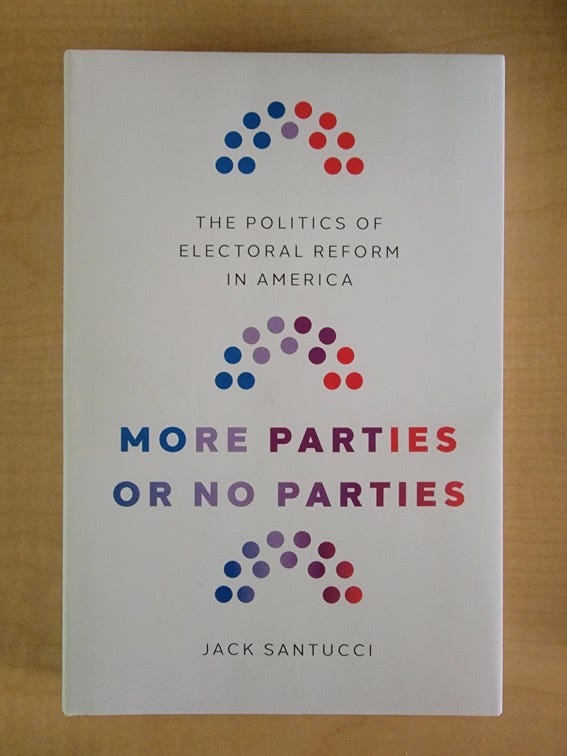
Photo by Phil Howe. Book available for purchase and in Oxford Scholarship Online.

The space of politics is multidimensional. What we call “left” and “right” are negotiated positions.

Interest groups (broadly understood) do the negotiating. They are assumed to want control of government. They form coalitions to get it.

Every democracy has some coalition structure, even if it does not track party division.

‘Shifting coalitions’ lead to electoral reform: incumbent groups seeking insulation, out-of-power groups seeking realignment, or opposing groups seeking to discipline noncommittal players (a polarizing mode).

Electoral reform is change in any of five electoral-system components: assembly size, district magnitude, ballot type, allocation rules, and rules about nominations.

Two-party politics makes it tempting to cater to factions, not parties, when proposing and designing reforms. Witness the current emphasis on ballot type and nominations (ranked-choice, approval voting, nonpartisan primaries). Witness the unpopularity (outside political science) of allocation rules that presume party grouping (such as party-list proportional representation, including mixed-member).

In the past, reformers promoted single transferable vote (STV) and ranking generally in order to cater to factions, not parties.

In other countries, multiparty politics facilitates use of ranked-choice: giving voters understandable entities to rank, instructing voters on how to rank (vote management), regulating candidate entry (vote management), and generating political will to administer a complex system.

In the United States, ranked-choice reforms tended to last as long as the coalitions that imposed them.

Vote management was imperfect and slow to emerge. It usually involved a bipartisan coalition that sold itself in “good government” terms.

Due to vote management, STV produces winners who usually would be the same under open-list proportional representation (OLPR).

An exception is when the coalition structure shifts, such that some voters do not rank candidates in the way that party (or interest-group) leaders might want. Said voters are part of a coalition structure that is different from the prevailing one.

If the alternative coalition deprives “left” and “right” of control of government, they may join in blaming the electoral system. This can lead to a polarizing repeal episode.

Reasons for abandonment of majoritarian ranked-ballot rules are not yet well-understood. One theme in the literature is ranking truncation. Another is the production of surprise results. These may have reinforced each other: many voters not ranking very many choices, determined candidates capitalizing on this.

The repeal of early ranked-choice systems left in place features that had been needed to pass ranked-choice. These include nonpartisan ballots, numbered-post elections, and single-digit assemblies.

This post also appeared at on Medium.

The one-vote system

Kevin Kosar of the American Enterprise Institute generously invited me to do a Q&A on the ‘one-vote system’ — and candidate-based forms of list PR in general. The Q&A builds on my recent op-ed in The Philadelphia Inquirer. You can read the Q&A here.

There’s a tendency in reform circles to ask too much of voters. I’m thinking here of elaborate schemes like RCV, STAR (Score Then Automatic Runoff), and approval. Ballot reforms like these basically ask voters to pick a better coalition. One-vote flips that around — give voters representation, then have their representatives form the coalition. It’s a lot more realistic.


Quick & dirty open-list PR allocation of 2018 US House seats

Here is what part of the US House would have looked like, 2019-20, if seats had been allocated under open-list PR based on votes in primaries. The results assume statewide allocation. I used a Hare quota and largest-remainder rule. I also removed runoffs from the data.

What is open-list PR? In this case, you vote for one candidate. This vote counts both for a person and a party.

This is not really the right way to do this. I used primary votes as a way to see how intra-party factionalism might find expression… and as a way to see what might happen if parties just ‘got rid of primaries,’ instead letting anyone who wants join the list (subject to whatever ballot access rules exist for primaries). Problems with my math are: (a) fewer people vote in primaries than generals; (b) not all districts saw primaries.

Anyway, maybe someone will find something interesting in the results. Let me know if you do!

Thanks to this crew for making the primary data available:


A fresh look at staggeringly high invalid-ballot rates in historic RCV elections

Nearly three years ago, I had a long-ish post on the “voter confusion” question in ranked-choice elections. The core point was that invalid-ballot rates seemed to surge when movement-type people ran for office. Presumably, they were mobilizing the sorts of voters who either hadn’t voted before in an RCV election, or had the sort of socioeconomic profile that one might associate with ballot error.

The new insight is “X voting.” This is an old term for when people use the letter X to mark an RCV ballot. As you can see from my sample ballots, it seems to have been a big problem. The very first instruction on these ballots is: “DO NOT USE X MARKS.”

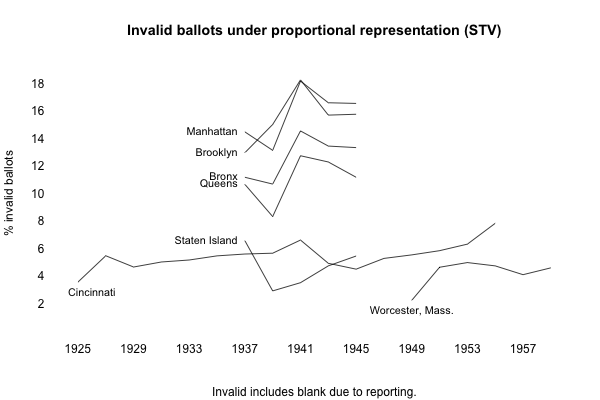
Rates of invalid voting in New York City were staggering. In Brooklyn and Manhattan in 1941, for example, the invalid rates approached 20 percent. About one quarter of that came from blank ballots. (Data on blank ballots do not exist after 1941.) Here is the graphic from the original post:

Here’s how we know that voters were using multiple X marks. The rules were very inclusive. If you voted with just one X, that was taken as your first-place ranking, and the ballot counted as such. If you voted with a combination of X’s and numbers, the X’s were disregarded. So, for a ballot to be invalid, it had to contain only X’s, and more than one of them. More on that from this tweet thread.

The city could have stopped all this by moving to IBM’s STV voting machine. There are references to this machine in the 1937 city charter, in fact, so people were aware of the problem and intended to solve it. I am not sure why the solution never came.

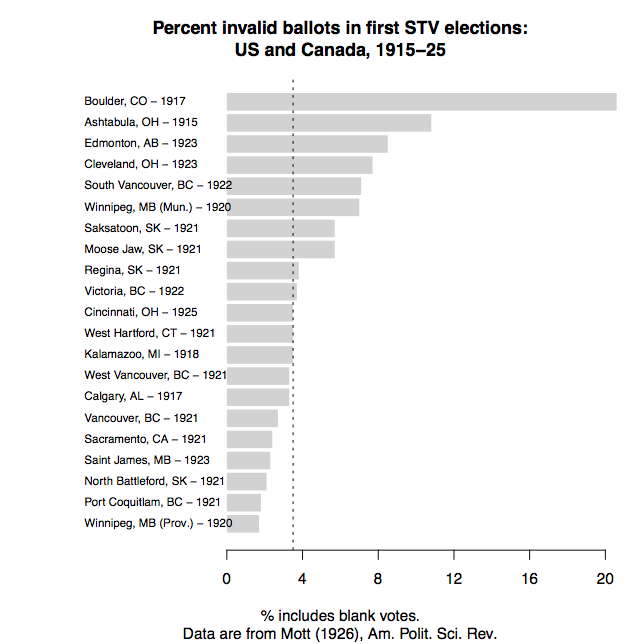
Here are more invalid rates from very early STV elections, both in the U.S. and Canada. Some are alarmingly high. We also see that they tended to decline as there was more public experience with STV. Something must have improved — voter education, ballot designs, party coordination, whatever. The data come from Mott (1926).

Aside from using a voting machine that does not permit X voting, reformers could have promoted Gosnell’s “list system with single candidate preference” — otherwise known as open-list proportional representation (OLPR). I don’t have the statistics handy, but I think that versions of this are the most common type of PR in countries without mixed-member systems.

Gosnell called for a “single candidate preference” because reformers at the time were intellectually committed to the single transferable vote — “if your vote doesn’t count for your first choice, it counts instead for your second,” and so on. But Gosnell’s OLPR system could have worked with multiple votes too — the sort of X voting that drove up these error rates. It also could have been made to work with multiple votes across different party lists (i.e., ticket-splitting).

Final thought: I do not want to suggest that RCV is a bad idea, destined to generate mass confusion and disenfranchisement. We do not live in 1941, and no American voter is asked to mark RCV ballots with a pencil anymore. (Although, if we must have PR, I am starting to prefer open lists.)

A related issue is that we do not know what ballot invalidity is like in non-RCV races, especially when voters are asked to express more than one preference. I am thinking here of at-large elections. Studies of that are pretty rare, and we need more of them. One such study is this.