Skip to content

Los Angeles, 1913: STV or OLPR?

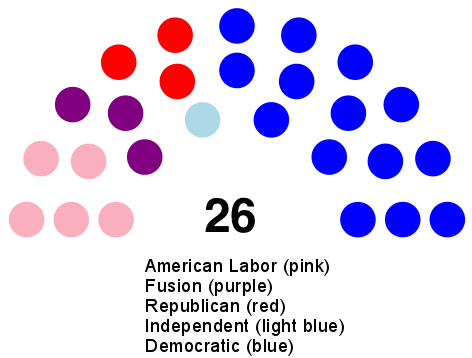
How we understand Los Angeles matters. I claimed in a recent piece that the 1913 defeat of open-list PR there was a critical juncture for American PR advocacy. (I recently learned of a similar event in Western Europe, with the opposite effect. More on that another time.) Recently, there appeared two articles saying that the referendum was on STV. So, which was it?

Read more…

Good summary of my argument, plus a thought on lists

Ned Foley has an excellent summary of my technical argument about STV repeals.

I wonder if the fractional-transfer approach would mitigate vote leakage.

The problem is that voters don’t understand it, which is what spurred the original post.

I argue in the book that there are three ways to deal with this: have a multiparty system (that can dictate rankings and/or in which it is incentive-compliant for a majority to retain the system), use list-based allocation (possibly within STV), or somehow maintain a majority that can limit its own nominations.

My hunch is that similar issues (minus ranking and limiting endorsements) also might apply to D’Hondt. Thoughts?


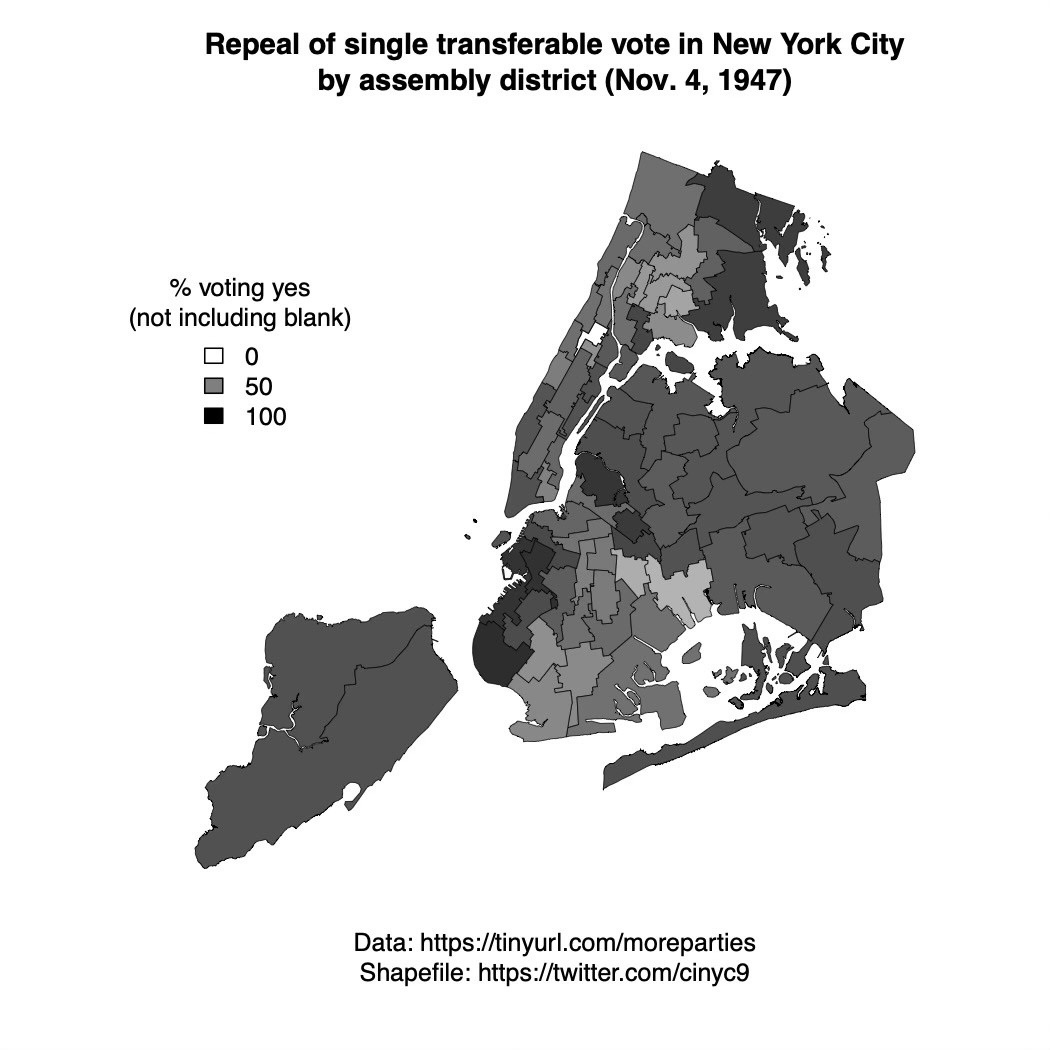
Mapping the repeal of proportional representation in New York City

I may have more to say about this later.

Two sorts of hypotheses might explain the variation. One concerns third-party strength (Labor, Liberal, Communist). But ecological inference suggests a divided Labor Party!

The other sort concerns politics of urban renewal. This may help explain the pockets of opposition in Bronx and Brooklyn. Also in the book, I analyze the City Council roll-call record. Those data suggest a faction of the Republican Party feuding with the O’Dwyer (D) administration and other Republicans on budget matters.

Another point worth mentioning: this was one of few repeals (the only?) that increased assembly size. So, there may be a counterintuitive representation story too.

Feel free to comment if anything strikes you.


Some key points from “More Parties or No Parties”

Photo by Phil Howe. Book available for purchase and in Oxford Scholarship Online.

The space of politics is multidimensional. What we call “left” and “right” are negotiated positions.

Interest groups (broadly understood) do the negotiating. They are assumed to want control of government. They form coalitions to get it.

Every democracy has some coalition structure, even if it does not track party division.

‘Shifting coalitions’ lead to electoral reform: incumbent groups seeking insulation, out-of-power groups seeking realignment, or opposing groups seeking to discipline noncommittal players (a polarizing mode).

Electoral reform is change in any of five electoral-system components: assembly size, district magnitude, ballot type, allocation rules, and rules about nominations.

Two-party politics makes it tempting to cater to factions, not parties, when proposing and designing reforms. Witness the current emphasis on ballot type and nominations (ranked-choice, approval voting, nonpartisan primaries). Witness the unpopularity (outside political science) of allocation rules that presume party grouping (such as party-list proportional representation, including mixed-member).

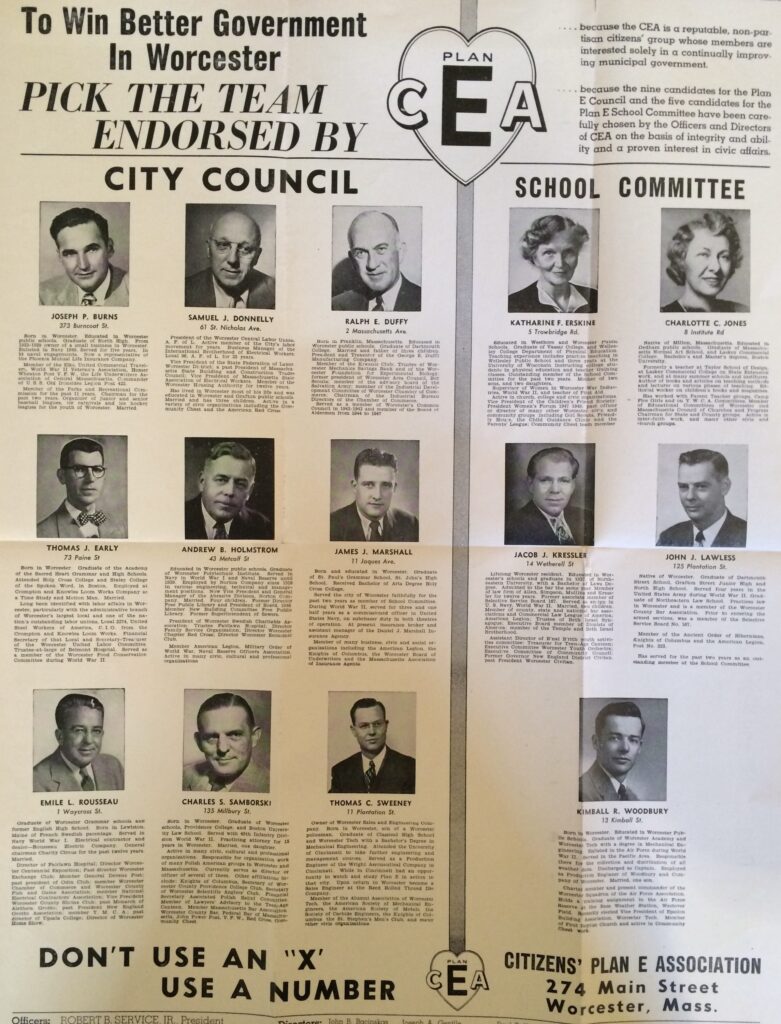
In the past, reformers promoted single transferable vote (STV) and ranking generally in order to cater to factions, not parties.

In other countries, multiparty politics facilitates use of ranked-choice: giving voters understandable entities to rank, instructing voters on how to rank (vote management), regulating candidate entry (vote management), and generating political will to administer a complex system.

In the United States, ranked-choice reforms tended to last as long as the coalitions that imposed them.

Vote management was imperfect and slow to emerge. It usually involved a bipartisan coalition that sold itself in “good government” terms.

Due to vote management, STV produces winners who usually would be the same under open-list proportional representation (OLPR).

An exception is when the coalition structure shifts, such that some voters do not rank candidates in the way that party (or interest-group) leaders might want. Said voters are part of a coalition structure that is different from the prevailing one.

If the alternative coalition deprives “left” and “right” of control of government, they may join in blaming the electoral system. This can lead to a polarizing repeal episode.

Reasons for abandonment of majoritarian ranked-ballot rules are not yet well-understood. One theme in the literature is ranking truncation. Another is the production of surprise results. These may have reinforced each other: many voters not ranking very many choices, determined candidates capitalizing on this.

The repeal of early ranked-choice systems left in place features that had been needed to pass ranked-choice. These include nonpartisan ballots, numbered-post elections, and single-digit assemblies.

This post also appeared at on Medium.


The parties’ asymmetric problems and the difficulty of electoral reform

People on both sides of politics agree on the need for some kind of electoral reform. “The current system isn’t working,” we hear often.

Yet the reformers on each side face a different set of problems. This leads to diverging institutional preferences: in terms of seats/votes proportionality and expected effects on party discipline. The result will be no reform at all, state/local efforts to promote “proportional ranked-choice voting,” or a set of compromises (policy- and office-seeking) that neither side seems willing to make.

The Democrats’ problems

Democrats face two related problems. One is insufficient party discipline. Witness the failure last December to shepherd voting-rights legislation through the Congress. Or the scuttling of Joe Biden’s Build Back Better legislation.

A second problem, well-documented by Rodden and the gerrymandering crew, is the concentration of their voters in population-dense regions. This is why we hear that Democrats are disadvantaged, relative to Republicans, when it comes to translating votes into proportional (or better) shares of seats.

These problems are related because, to win congressional majorities, Democrats must appeal to voters in conservative areas. Hence the production of a caucus whose own members defeat its priorities.

If I have captured the problems accurately, the institutional prescription is straightforward. Find a reform that undoes the geography problem, then makes individual members more beholden to party leadership: list PR.

The Republicans’ problem

Republicans’ problem is much different. The NeverTrump wing of the party has a #PrimaryProblem. Solving the #PrimaryProblem requires replicating the Murkowski coalition. In turn, that requires permitting two Republican parties to present themselves on one ballot, then getting a sufficiently large group of Democrats to cross over.

The reform solution is accordingly different: preserve single-seat districts, and break the major parties into factions.

Prospects for reform

If I have characterized the situation accurately, there is little hope for a congressionally imposed solution. Democrats need proportionality and more leadership control of nominations. Republicans need disproportionality (i.e., the district-structure status quo) and less leadership control of nominations. Democrats from conservative districts may face similar incentives.

What about how the expected number of parties affects reform prospects? Some Democrats likely do not want the party’s left wing to bolt. Republicans likely do not want a governing coalition to include that party. Hence some opposition to PR in both camps. And others may be steeped in the idea that multiple parties equal instability.

For various reasons, I don’t think the bolt is likely. Even if it happened, it might not matter — if reform made parties stronger, leading to the style of coalition politics that we find in most other democracies.

Further implications

Very few observers are making any sort of case for list PR. One possible reason is precisely that list PR implies greater leadership control of nominations.

Further, list PR does not ‘work’ with a system of nonpartisan elections. Only the single transferable vote (STV) can show progress if the goal is to create “demonstration cases.” Given the analysis of congressional prospects above, demonstration cases may be the best a reformer can do.

Is there a way out?

No, probably not without some policy concessions.

For Democrats, the Republican reforms mean leaving Republicans in control of the House. For Republicans, the Democratic reforms mean splitting the GOP in two — full-blown parties, not factions, to regulate the party lists — as well as ceding House control for the foreseeable future. It also might mean giving up the White House, unless the two Republican parties fused to contest those races.

Should there be a way out?

Yes, I think we are at a pivotal moment. I think our grandkids will speak poorly of us for failing (a second time) on voting rights, then leaning into ‘incremental’ reforms with an iffy track record.