John Ketcham and I have a new report out today with the Manhattan Institute. In it, we show that the effective number of electoral parties at the last New York City council election was 3.3. We defend this computation by reference to the seat-product model. Then we simulate two forms of proportional representation: open-list at the borough level, mixed-member PR with a citywide compensation tier of 20 seats.
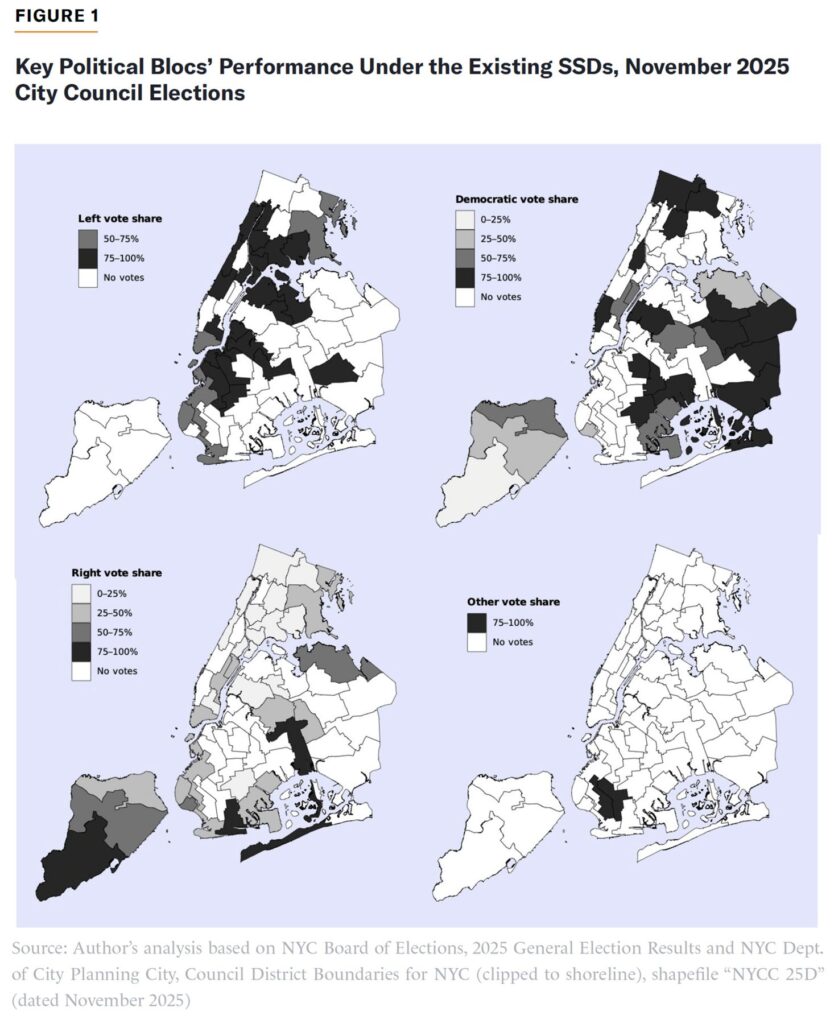
Separate from the simulations, the dynamics of the Democratic primaries speak to the potential value of having party factions compete as separate entities. PR’s rival reforms seek to manage fragmentation by funneling voters’ preferences through some form of two-round election.[23] These proposals take SSDs as a point of departure because many believe that they deter third-party entry.[24] Instead, the key intervention is to make it easier for voters not affiliated with a party to affect the candidate it sends to a general election (i.e., primary reform). This assumes that a party’s regulars also are its “extremists.” However, the Working Families Party won 23 council seats by winning the respective Democratic primaries. Data from the NYC Campaign Finance Board (CFB) suggest this may have been due to new-voter mobilization rather than the outsized influence of party regulars. Working Families saw a 157% increase in registrations, followed by 78% for Democrats, 53% for Republicans, and 32% for Conservatives. New registrations concentrated among voters under 30 (64.8%). Further, CFB notes that single-day registration before the deadline beat 2021’s record fivefold.[25] This surge occurred in a context of closed party primaries, which are widely thought to impede participation by voters not tied to either major party.[26] “Moderation” via primary reform therefore may require voter mobilization to counteract whatever is its target.
The usual case against PR is that it might break up existing political parties. The New York City party system is already fragmented.[27] When we treat candidates’ combinations of party endorsements as parties in their own right, the effective number of electoral parties is 3.3. Note that this situation obtained under the current “first-past-the-post” system. It also obtained in a system that should be expected to produce 2.7 parties without any electoral reform.
Have a look!
Faced with OLPR or MMP rules rather than SSD rules, would the Working Families Party still endorse some Democrats, would the Conservatives still endorse some Republicans, and so on? What implications does the answer to that question have for the utility of your decision to treat groups of fusion candidates (e.g. WFP/Dem) as separate parties, distinct from groups of candidates endorsed by only one party?
Also, what would the ENP be if you had decided to treat each candidate as belonging only to the party she identifies with?
More generally, what is the relevance of fusion to legislative elections held under PR rules?
Good questions.
1. I don’t know. What do you have in mind?
2. I may not understand the question. At a surface level, those parties would be counted as independent entities.
3. I don’t know because I didn’t look up the registrations of the candidates. However, the ENP is 1.6 when we disregard fusion (e.g., count an R/C candidate as an R). Your thoughts?
4. At a surface level, I suspect one needs to go to the joint-list literature on Latin America. I am aware of Americanist work on the effects of fusion endorsements, but that does not necessarily speak to PR dynamics.
Jack, on page 4, how does an assembly size of 51, all single-seat, get you to an expectation for ENP of 2.7? The formula I learned gives me 1.9.
On whether Dem and Dem/WFP should be counted as separate parties, I need to look at Predicting Party Sizes, which you cite in support of your rationale, also on page 4.