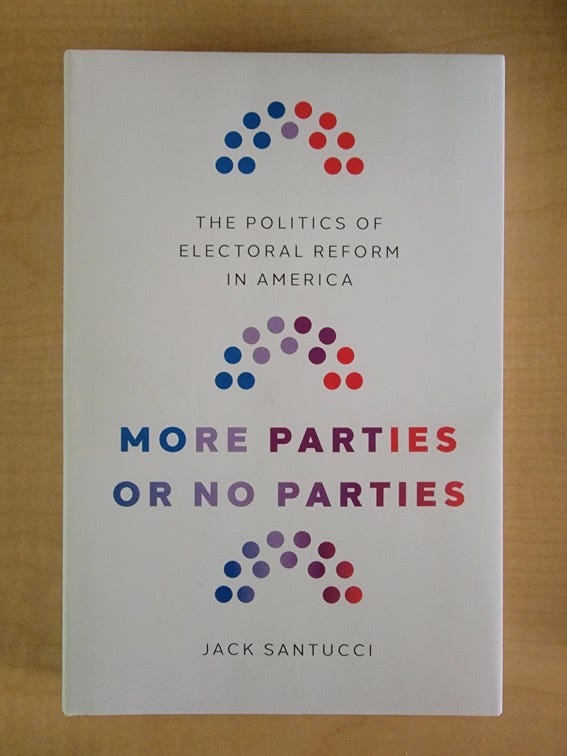
I have a new report with Kevin Kosar and Jaehun Lee of the American Enterprise Institute:
Key Points
Portland, Oregon, used its decennial charter revision process to overhaul its method for electing the city’s legislators in 2022.
The new system divided the city into four districts, with each district represented by three members selected through ranked ballots.
Portland first used this new system in November 2024, and initial analysis indicates that it expanded the representativeness of the candidate pool and resultant council.
I have been mentioning this article a lot lately, so I figured I’d blog it. Here are some key excerpts:
More than one in 10 votes were ruled invalid in the multicultural seat of Fowler, raising serious questions about whether explanations of Australia’s compulsory preferential voting system are getting through.
Fowler, in Sydney’s south-west, has one of the highest non-English-speaking populations, many of whom have come to Australia as refugees from countries with very different political systems.
And:
She said the centre had just run a campaign, Civic Spotlight, that aimed to educate migrant communities about the voting system, but more needed to be done.
“The AEC, they are not doing enough to address it. They have resources online and they provide information in several languages but it’s not just about addressing community leaders, it needs to be one-on-one,” she said.
I recently referred to the AEC (Australian Electoral Commission) as one of “the sorts of agencies that like running STV elections.”
The space of politics is multidimensional. What we call “left” and “right” are negotiated positions.
Interest groups (broadly understood) do the negotiating. They are assumed to want control of government. They form coalitions to get it.
Every democracy has some coalition structure, even if it does not track party division.
‘Shifting coalitions’ lead to electoral reform: incumbent groups seeking insulation, out-of-power groups seeking realignment, or opposing groups seeking to discipline noncommittal players (a polarizing mode).
Electoral reform is change in any of five electoral-system components: assembly size, district magnitude, ballot type, allocation rules, and rules about nominations.
Two-party politics makes it tempting to cater to factions, not parties, when proposing and designing reforms. Witness the current emphasis on ballot type and nominations (ranked-choice, approval voting, nonpartisan primaries). Witness the unpopularity (outside political science) of allocation rules that presume party grouping (such as party-list proportional representation, including mixed-member).
In the past, reformers promoted single transferable vote (STV) and ranking generally in order to cater to factions, not parties.
In other countries, multiparty politics facilitates use of ranked-choice: giving voters understandable entities to rank, instructing voters on how to rank (vote management), regulating candidate entry (vote management), and generating political will to administer a complex system.
In the United States, ranked-choice reforms tended to last as long as the coalitions that imposed them.
Vote management was imperfect and slow to emerge. It usually involved a bipartisan coalition that sold itself in “good government” terms.
Due to vote management, STV produces winners who usually would be the same under open-list proportional representation (OLPR).
An exception is when the coalition structure shifts, such that some voters do not rank candidates in the way that party (or interest-group) leaders might want. Said voters are part of a coalition structure that is different from the prevailing one.
If the alternative coalition deprives “left” and “right” of control of government, they may join in blaming the electoral system. This can lead to a polarizing repeal episode.
Reasons for abandonment of majoritarian ranked-ballot rules are not yet well-understood. One theme in the literature is ranking truncation. Another is the production of surprise results. These may have reinforced each other: many voters not ranking very many choices, determined candidates capitalizing on this.
The repeal of early ranked-choice systems left in place features that had been needed to pass ranked-choice. These include nonpartisan ballots, numbered-post elections, and single-digit assemblies.