Skip to content

What do we know about historic use of IRV in nominating primaries?

Alan Ware (2002, p. 231) writes the following. His book covered the politics of nominating primaries. Its key contribution was to argue that major-party leaders imposed direct primaries to help avoid party splits.

Maryland and Minnesota (both in 1912) had started to use the Alternative Vote electoral system for their primaries. The other possible solution for ensuring majority nominations – the run-off election – was deployed in six southern states, five of which had adopted it before 1917. Indeed, at various times other states had also used forms of so-called preferential voting to ensure that nominees were not the choice of merely a small minority.10 The solutions to the problem of vote fragmentation were well known. The far more intractable problems posed by direct primaries for the parties were, first, interest aggregation, because nomination decisions were now individualized, rather than being considered as part of a “package.” This increased the likelihood of intraparty tensions, and also the risk that unelectable tickets might result. The second problem was that the direct primary both reduced the ability of the party to control the “quality” of candidates selected, and in some cases made it more possible that wealthy individuals might triumph over poorer rivals having broader support among party activists.

Weeks (1937) gives the fullest account of these systems. Whether voters will use rankings sufficient to “guarantee” majority winners is an issue. There also is an open question in the literature: do single-seat reforms (like IRV) eventually induce coordination failure (so that voters do not use markings to get majority-supported outcomes)? Here is what Weeks says about these issues:

1. All states except Alabama and Oklahoma did not require the voter to register more than a first choice for any office. It seems to have been quite common in all the states indicated above that a great many voters failed to avail themselves of the privilege of registering second or more choices, which resulted in the practical restoration of the plurality system in many primary races. This failure was due to several causes: ignorance of the voter; his desire not to have his vote counted for any but his first choice; or his refusal to accept what was thought to be a complicated system, which, it was felt, could be easily corrupted or readily subject to mistakes in the count, or which seemed to provide for an unfair method of evaluating choices.

2. Failure of party leaders and officials to educate the public in the use of the preferential feature, due partly to their opposition to it as a complicated device and one the results of which could not be easily anticipated.

Weeks’ article contains a table of the 11 states that used IRV or the Bucklin system within primaries. Four had gone to runoffs by 1931. Six had gone to plurality. One more (Maryland) continued using a ranked-ballot system through 1937.

I touched on these issues here (pp. 177-180). The topic would make for an interesting research project.

Philadelphia ranked-choice: early observations

The local paper of record has endorsed RCV in the context of a crowded Democratic mayoral primary. It also has called for nonpartisan elections (potentially with runoffs). How the latter might affect the former is left to the reader.

The endorsement followed a poll by several pro-RCV groups. One is pushing simultaneously in Harrisburg for open primaries.

I have been following the issue since I got here in early 2019. The Philadelphia Citizen wrote about it in 2016. There were murmurs of interest in good-government circles but not much more. (Hence we found the site useful for a survey experiment.) National groups became vocal in Spring 2021, shortly after New York City adopted RCV for primaries.

I discussed the issue on Philly NPR in late April.* Billy Penn ran a story earlier that week.

Here is a piece I wrote in October 2021. It recommended open-list proportional representation. (The conversation at the time was less mayor-centric.) It also noted that a Philadelphian had invented list PR in the 1840s. This was partly to address the unpredictability of runoffs.

*The interview refers to me as an assistant professor. I am flattered but not one.


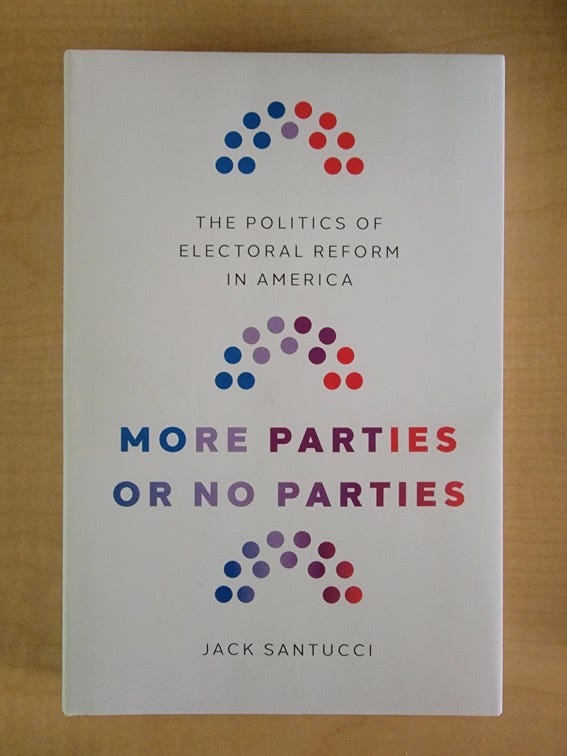
Some key points from “More Parties or No Parties”

Photo by Phil Howe. Book available for purchase and in Oxford Scholarship Online.

The space of politics is multidimensional. What we call “left” and “right” are negotiated positions.

Interest groups (broadly understood) do the negotiating. They are assumed to want control of government. They form coalitions to get it.

Every democracy has some coalition structure, even if it does not track party division.

‘Shifting coalitions’ lead to electoral reform: incumbent groups seeking insulation, out-of-power groups seeking realignment, or opposing groups seeking to discipline noncommittal players (a polarizing mode).

Electoral reform is change in any of five electoral-system components: assembly size, district magnitude, ballot type, allocation rules, and rules about nominations.

Two-party politics makes it tempting to cater to factions, not parties, when proposing and designing reforms. Witness the current emphasis on ballot type and nominations (ranked-choice, approval voting, nonpartisan primaries). Witness the unpopularity (outside political science) of allocation rules that presume party grouping (such as party-list proportional representation, including mixed-member).

In the past, reformers promoted single transferable vote (STV) and ranking generally in order to cater to factions, not parties.

In other countries, multiparty politics facilitates use of ranked-choice: giving voters understandable entities to rank, instructing voters on how to rank (vote management), regulating candidate entry (vote management), and generating political will to administer a complex system.

In the United States, ranked-choice reforms tended to last as long as the coalitions that imposed them.

Vote management was imperfect and slow to emerge. It usually involved a bipartisan coalition that sold itself in “good government” terms.

Due to vote management, STV produces winners who usually would be the same under open-list proportional representation (OLPR).

An exception is when the coalition structure shifts, such that some voters do not rank candidates in the way that party (or interest-group) leaders might want. Said voters are part of a coalition structure that is different from the prevailing one.

If the alternative coalition deprives “left” and “right” of control of government, they may join in blaming the electoral system. This can lead to a polarizing repeal episode.

Reasons for abandonment of majoritarian ranked-ballot rules are not yet well-understood. One theme in the literature is ranking truncation. Another is the production of surprise results. These may have reinforced each other: many voters not ranking very many choices, determined candidates capitalizing on this.

The repeal of early ranked-choice systems left in place features that had been needed to pass ranked-choice. These include nonpartisan ballots, numbered-post elections, and single-digit assemblies.

This post also appeared at on Medium.


Interwar Fabians on ‘instant runoff’

The following is from a 1924 pamphlet on electoral reform by the Fabian Society. The context involves the Labour Party replacing the Liberals as the UK’s main opposition to the Conservatives. The pamphlet itself is about proportional representation, but this excerpt is from a section called “The Alternative Vote.” It is interesting to compare the attendant circumstances with some that now obtain in American nominating primaries.

The method is suggested as a safeguard against minority seats. It is true that the successful candidate would be able to boast of a mathematical majority as proof of his representative quality. But this mathematical majority would not be a majority in the English political sense of the word, i.e., a majority of positive supporters [emphasis in original]. The candidate would be returned partly by the votes given to him to keep other candidates, considered as less desirable, out; and this is no morally decent basis for a Representative Assembly. Moreover, as it is likely that within 15 years the Liberal Party will be electorally defunct, we shall then be troubled with fewer of such multiple-candidate contests. It would be the height of political unwisdom to introduce a new and vicious element into the constitution to counteract a temporary ill.


Does the Alternative Vote lead to STV?

I don’t think so. The logics of adoption are different. Yet the story of Cleveland (just below) suggests that it is possible… while rare.

AV finds favor where the majority can’t agree on the candidate it wants — but can agree on the one it doesn’t. AV is an agreement to passively form coalitions in elections. I say “passively” because the vote-transfer process does the work, likely with help from elite cues.

STV finds favor where the coalition is to be worked out actively, in a legislature. STV also preserves freedom to break the coalition between elections.

Read more…